
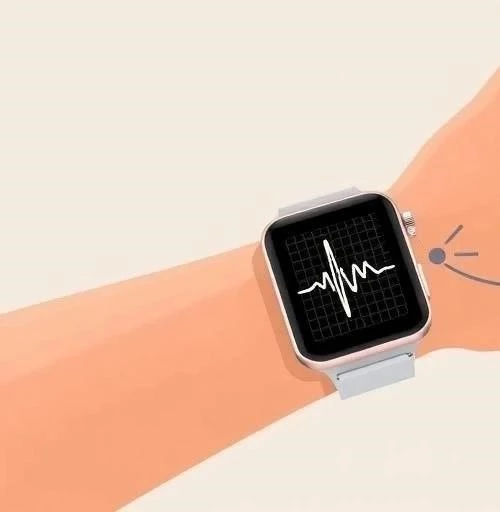
Apple Watch Series 4 can record a single-lead electrocardiogram (ECG) using the ECG app․ It detects the heart’s electrical signals—not simply its pulse—and turns them into a waveform that can be reviewed on the watch and in the Health app on a paired iPhone․ This is useful for capturing a snapshot of heart rhythm, but it is not a substitute for a medical ECG or a diagnosis․
What the watch measures
The recording uses two electrodes: one built into the back of the watch, which touches your wrist, and another in the Digital Crown․ When you rest a finger from your opposite hand on the crown, you complete an electrical circuit across your body․ The watch senses the tiny voltage differences produced by the heart’s electrical activity and records them for about 30 seconds․ Because the setup measures from only one direction, its tracing resembles one lead of a clinical ECG, not the standard 12-lead test․
How to take a reading
- Wear the watch snugly on the wrist selected in its settings, and open the ECG app․
- Rest your arms on a table or in your lap․ Keep the watch-wearing wrist and the finger on the Digital Crown still․
- Touch the crown gently with the opposite hand’s finger and hold contact until the countdown finishes․
Good skin contact and stillness matter: movement, a loose fit, or a poor connection can make the result inconclusive․ The app then classifies the recording—for example, as sinus rhythm, atrial fibrillation, a low or high heart rate, or an inconclusive result․ You can save the waveform as a PDF in Health and share it with a clinician․
What the result can—and cannot—tell you
The app is designed to identify signs of atrial fibrillation in eligible users, not to detect every heart condition․ A normal classification does not rule out a problem, and an inconclusive reading is not a diagnosis․ The watch does not check for a heart attack, blood clots, or all rhythm disorders, and its single lead offers less information than a clinical examination․ Availability and setup requirements can vary by country and software version․
Bottom line: Series 4 ECG is a convenient way to record a short electrical snapshot when you are still․ Treat it as useful information, not medical clearance․ If you have chest pain, shortness of breath, fainting, or another urgent symptom, seek medical care rather than relying on the watch․ For repeated unusual results or concerns, show the recording to a healthcare professional․

7 Comments. Оставить новый
The strongest part is the careful explanation of the app’s limitations. Clarifying that a normal result does not rule out a heart problem helps prevent readers from treating a smartwatch classification as a complete medical assessment.
The explanation of possible classifications is informative, and the cautions around inconclusive or normal results are responsible. A brief note that device availability can vary by region would make the overview even more complete.
The article presents the technology in a balanced way: it explains what the watch can measure while avoiding claims that it can detect every heart condition. The reminder that the recording can be shared with a clinician is also a helpful practical detail.
This is a sensible overview because it distinguishes an ECG, which records electrical activity, from a simple pulse reading. That distinction helps readers understand why the feature may offer useful information but still cannot replace a medical evaluation.
I appreciate that the article explains both how to take a reading and why a result may be inconclusive. That makes the guidance practical without suggesting that every recording will provide a definitive answer.
This is a clear explanation of how the watch creates an ECG recording, especially the description of the two electrodes and the need to stay still. The distinction between a single-lead reading and a clinical 12-lead ECG is important context for readers.
The step-by-step instructions are easy to follow, and the emphasis on a snug fit, steady hands, and good contact explains why technique affects the recording. This makes the article useful for someone using the ECG feature for the first time.