
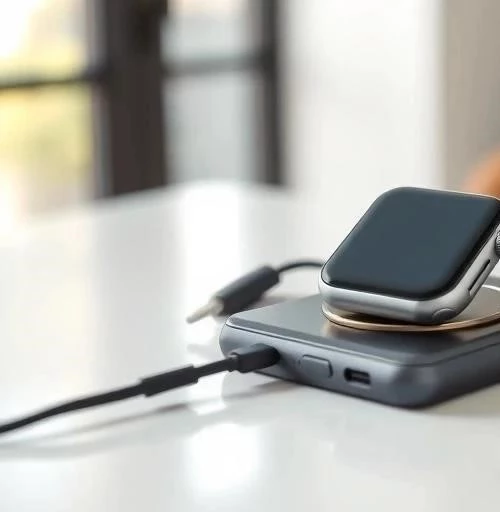
The short answer: you cannot safely charge an Apple Watch with no compatible charging puck or cable at all. The watch does not have a standard charging port, and its magnetic charging system is not the same as ordinary Qi charging. If your charger is missing, the practical solution is to find a compatible replacement—not to improvise a power source.
What to do instead
Borrow a compatible Apple Watch charger. Ask a friend, family member, hotel desk, or workplace whether they have one. Apple Watch models use magnetic charging accessories made for the watch. Check that the cable and adapter are undamaged, and place the watch on the puck so its back aligns with the magnet. A regular phone charging cable cannot connect directly to the watch.
Buy or borrow a replacement. Apple sells charging cables and docks, and reputable third-party manufacturers offer compatible products. Choose an accessory explicitly labeled for Apple Watch and, where available, certified or approved by Apple. Check that the connector suits your power adapter: some cables end in USB-C, while older ones may use USB-A. A USB-C power adapter is not itself a charger for the watch; the magnetic watch cable is still required.
Try a charger built into another device. Some power banks, bedside stands, and multi-device docks include a dedicated Apple Watch charging puck. They can work if the watch has a proper, compatible magnetic module. Simply placing the watch on a phone’s wireless charging pad usually will not charge it.
Why common “workarounds” fail
Apple Watch does not support charging by plugging a cable into the watch, and it generally cannot be charged by putting it on a standard Qi phone pad or on the back of a phone with reverse wireless charging. The watch’s magnets may align with some surfaces, but alignment alone does not make the charging technology compatible. Avoid videos or tricks that promise charging with coins, magnets, exposed wires, or a modified cable: these methods are unreliable and can cause burns, electrical damage, or battery failure.
Do not open the case or attempt to connect a bare battery or wire. Lithium-ion batteries can be hazardous if punctured, shorted, overheated, or charged with uncontrolled voltage. Likewise, stop using any puck or cable that is frayed, unusually hot, or visibly damaged. A working watch is not worth risking injury or destroying the device.
If you need to conserve power
If the battery is not yet empty, enable Low Power Mode, reduce unnecessary screen activity, and avoid workouts or apps that drain power. These steps may extend use, but they do not recharge the watch. Once it shuts down, you will need a compatible charger before it can turn on again.
Bottom line: there is no dependable, safe way to charge an Apple Watch without a compatible magnetic charger. Borrow one, use a charging dock or power bank with a built-in watch puck, or obtain a suitable replacement. This is safer and more reliable than attempting an improvised workaround.



8 Comments. Оставить новый
This is a useful explanation of why an Apple Watch cannot simply be placed on an ordinary phone charging pad. The distinction between a compatible magnetic charger and a regular power adapter is especially helpful for people trying to troubleshoot a missing charger.
The practical suggestions make sense: borrowing a charger or buying a compatible replacement is safer than experimenting with improvised methods. I also appreciate the reminder to check the cable and adapter for damage.
The explanation of magnetic alignment versus charging compatibility is a helpful distinction. A surface can hold the watch in place without actually being able to charge it.
A clear and sensible guide for someone who has misplaced their charger. It sets realistic expectations and points readers toward compatible replacements rather than suggesting unreliable tricks.
This article clearly explains that a USB-C power adapter alone cannot charge the watch. That detail could prevent readers from buying the wrong accessory when they only need the magnetic charging cable.
I found the advice about chargers built into docks and power banks useful. The key point is that the accessory needs a dedicated Apple Watch charging module, not merely a wireless charging surface.
This is concise while still addressing the most common misconceptions, including reverse wireless charging from a phone. The practical options are straightforward and safety-conscious.
The warning against using coins, exposed wires, or modified cables is important. With a small electronic device, an unsafe workaround could damage the watch or create a risk of overheating.