
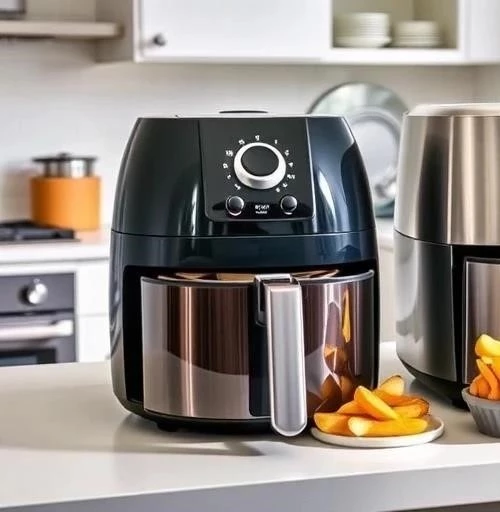
An air fryer is not a miniature deep fryer, despite its name. Think of it as a compact, powerful convection oven: a fan drives hot air around food, helping the outside turn crisp while the inside stays tender. The best one is not necessarily the biggest, newest or covered in buttons. It is the one that fits your kitchen, your appetite and the meals you actually make.
Here is the useful question: what do you want it to cook on an ordinary Tuesday? A handful of fries for one person calls for a different machine from dinner for a family of five. Start with that, then compare capacity, shape, controls and cleanup.
First, choose your air-fryer type
Basket model: the everyday specialist
A basket air fryer is compact, straightforward and usually a good first choice. Food sits in a drawer-style basket while hot air circulates around it. It works especially well for fries, vegetables, chicken pieces and reheating leftovers. The basket is easy to pull out and shake halfway through cooking, which helps food brown more evenly.
Choose this style if you want a simple machine for regular portions and have limited counter space. A single basket is less convenient when you want to cook two foods at different temperatures or keep a main dish separate from a side.
Dual-basket model: two dishes, one dinner bell
Two independent drawers let you cook, for example, salmon in one compartment and potatoes in the other. Many models allow separate temperature and timer settings; some can synchronize the finish times. That can make family dinners easier, but the two baskets are not always as roomy as one large compartment. Check the usable dimensions, not just the advertised total capacity.
Pick a dual-basket machine if you regularly cook different foods at once. Skip it if you usually make one large item or rarely use more than one drawer: extra controls and counter space are not automatically extra convenience.
Oven-style model: more room, more versatility
These machines open like a small oven and may include shelves, a rotisserie spit or mesh trays. They can be useful for larger portions, toast-like jobs and foods that need a flat surface. The trade-off is a bigger footprint and, depending on the design, more parts to wash. They may also need careful tray rotation for even browning.
Choose an oven-style air fryer if you have space and want a compact countertop oven, not merely a basket for crisping snacks.
Capacity: shop for portions, not impressive numbers
Manufacturers may state capacity in litres, quarts or food weight, and those figures do not always describe the same usable space. A tall chamber can have a generous volume but a small cooking surface. For crisp results, food needs room for air to move. A crowded basket tends to steam food instead of browning it.
- One or two people: a compact basket may be enough for snacks and side dishes.
- Three or four people: consider a larger single basket or a dual-basket model, depending on whether you cook one dish or two.
- A larger household: look for a wide cooking area, two drawers or an oven-style unit. Check whether a whole chicken or your usual tray actually fits.
These are starting points, not laws: appetites, batch cooking and kitchen habits matter. If you often cook in batches, a smaller unit may still work, but it will take longer to serve everyone.
Features worth paying attention to
- Temperature and timer controls: clear, easy-to-adjust settings matter more than a long menu of presets. Presets are convenient starting points, not guarantees that every food will finish perfectly.
- Wattage and preheating: power affects heating, but cooking results also depend on basket design, load size and airflow. Follow the manual’s guidance rather than choosing by wattage alone.
- Shake or turn reminders: helpful for foods that need moving, though they do not replace checking doneness.
- Dishwasher-safe parts: useful if you will really use the dishwasher. Confirm which components are safe, and whether the basket coating needs gentler care.
- Noise and size: fans make sound, and a machine must fit both your counter and the space around it. Measure before ordering.
- Repair and warranty support: a recognizable service route and accessible replacement parts can matter more than a flashy app.
What should you not overpay for?
A phone connection, dozens of presets and glossy touchscreens can be pleasant extras, but they cannot rescue a cramped basket or awkward cleanup. Likewise, the “maximum temperature” is only one specification. Even cooking, comfortable controls and a basket you can wash without a wrestling match are better everyday luxuries.
Be cautious with claims that an air fryer makes every food “healthy.” It can use less added oil than deep-frying, but the ingredients still count. It is a cooking method, not a nutrition spell.
A quick buyer’s test
- Write down the three foods you expect to cook most often.
- Estimate your usual number of portions, then check the basket’s width and usable layout.
- Decide whether you need one cooking zone, two separate zones or oven-style shelves.
- Look up cleaning instructions, dimensions, warranty and local service options.
- Compare the full cost, including accessories you genuinely need—not a bundle of trays that will live in a cupboard.
So, which one is best?
For a first purchase and a small household, a simple basket model is often the sensible choice. For dinners with separate mains and sides, a dual-basket model earns its space. For larger portions and broader countertop-oven use, consider an oven-style design. There is no universal champion; there is only the machine that makes your routine easier.
The final rule: buy the simplest air fryer that has enough cooking room for your real meals. Measure the counter, leave space for ventilation as the manufacturer instructs, and choose removable parts you can clean comfortably. The best model is not the one with the loudest promise. It is the one you reach for again tomorrow—because dinner came out crisp, cleanup was painless, and the kitchen still has room for a cup of tea.
7 Comments. Оставить новый
I like that this treats kitchen space as a real ingredient. A machine can have all the features in the world, but if it lives in a cupboard, it’s mostly an expensive metal paperweight.
The “ordinary Tuesday” test is a refreshingly practical way to shop. It turns a wall of buttons and promises into one useful question: what will actually earn its place on the counter?
The article gives each design a distinct personality: the basket is the reliable weeknight cook, the dual-basket is the dinner choreographer, and the oven-style model is the ambitious multitasker.
A useful reminder that “capacity” can be a slippery word. I’d never thought to compare the actual usable dimensions rather than letting a big number do the shopping for me.
I appreciate the calm skepticism toward feature overload. Sometimes the best appliance isn’t the one that can do everything; it’s the one you can operate before your coffee has kicked in.
This reads like a small act of resistance against buying kitchen gadgets by hype alone. Start with dinner, measure the counter, then let the machine audition for the job.
The dual-basket advice is especially helpful. “Two drawers” sounds like a guaranteed upgrade until you remember that two small compartments may not welcome a giant batch of potatoes.