
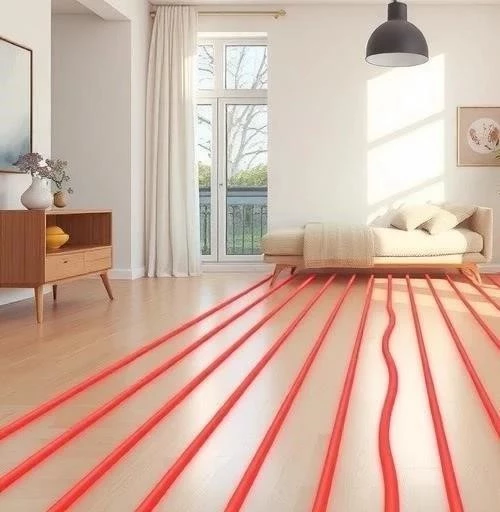
A warm floor sounds like a small domestic miracle: winter arrives, yet your feet meet a gentle sunrise instead of cold tile. But is it worth installing? The answer depends less on the heating technology itself than on insulation, room use, energy prices and how well the system is designed. Treat it as part of your home’s heating strategy—not a fashionable accessory—and it can improve comfort without inflating bills.
Start with the building, not the thermostat
Heat escaping through an uninsulated base is money disappearing into the ground. Before choosing equipment, check floor insulation, draughts and the home’s overall heat loss. Insulating the subfloor may deliver better savings than adding more heating capacity. A warm floor works best in a reasonably efficient building, where it can run at a low, steady temperature.
Choose the system for the job
A hydronic underfloor system circulates warm water through pipes. It can be an efficient primary heat source, especially when paired with a heat pump or a well-designed gas boiler. Installation usually costs more, and floor construction may require a substantial screed, but operating costs can be attractive over time.
An electric underfloor system is simpler to fit in a single room or renovation, though electricity tariffs can make continuous whole-home heating expensive. An infrared floor system is another electric option; its appeal is quick, local comfort, not a guarantee of lower bills. Any system can serve as supplementary heat, while making it the primary source requires careful heat-loss calculations.
Small controls, meaningful savings
Use a thermostat and floor-temperature sensor to prevent overheating. A programmable thermostat can lower the setting when rooms are empty, while zoning lets bedrooms, bathrooms and living spaces follow different schedules. Gradual, even heating is usually more comfortable than repeated bursts of high heat. Check that the floor covering is suitable, and follow the maker’s temperature limits.
Compare the whole-life cost
Installation cost is only the opening chapter. Estimate energy use, maintenance, expected service life and local tariffs; then compare these with your current heating bills. A payback calculation should include insulation improvements and the cost of any new boiler or heat pump. Hydronic systems need periodic checks; electric systems are often low-maintenance, but faults beneath a finished floor can be disruptive. Ask installers for a design, warranty and realistic running-cost estimate—not just a price per square metre.
Modern heating technology is most useful when it responds to the home rather than heating every room alike. Match the floor to the building, insulate first, control temperatures thoughtfully and compare actual tariffs. That approach can reduce utility costs while delivering quiet, even warmth. A warm floor is not automatically a bargain; it becomes one when comfort, efficiency and the full lifetime budget agree.
Keyword reference
тёплый пол; водяной тёплый пол; электрический тёплый пол; инфракрасный пол; отопление дома; энергоэффективность; экономия на отоплении; расходы на отопление; стоимость монтажа; эксплуатационные расходы; отопительная система; основной источник отопления; дополнительный обогрев; теплопотери; теплоизоляция пола; утепление основания; стяжка пола; напольное покрытие; терморегулятор; датчик температуры; программируемый термостат; зональное отопление; равномерный прогрев; температура пола; потребление электроэнергии; тарифы на электричество; тепловой насос; газовое отопление; расчёт окупаемости; срок службы; обслуживание системы; монтаж тёплого пола; выбор тёплого пола; современные технологии отопления; снижение затрат на коммунальные услуги.


1 Comment. Оставить новый
The best line of defense against a chilly floor may be the humble insulation layer, not a clever thermostat. I like how this turns underfloor heating from a luxury fantasy into a systems question: fix the heat loss first, then choose the technology that fits the room and the home. Comfort, it turns out, is engineered from the ground up.