
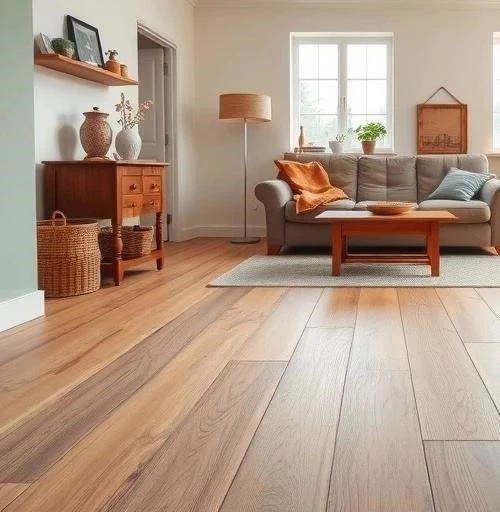
The project and the choice
During a country house renovation, the owners of a 92-square-metre home needed a durable floor for the living room, bedrooms and hallway. They considered ceramic tile, engineered wood and laminate. Their choice of flooring had to account for a house that was occupied mainly from spring to autumn, with occasional winter visits. Practical renovation experience shows that the product label alone is not enough: the building’s heating pattern, indoor humidity and subfloor condition matter just as much.
The owners selected 10 mm laminate with a suitable wear class for residential use and a water-resistant surface. This laminate for a cottage was not treated as waterproof; spills still needed prompt attention. Before buying, they checked the manufacturer’s guidance on temperature fluctuations, seasonal heating and compatibility with underfloor heating. They also ordered extra boards for cuts and possible future repairs.
Preparation and installation
Subfloor preparation took more time than expected. The old floor was removed, loose areas were repaired, and floor leveling compound was used where measurements showed unevenness. The base was then left to dry fully. This step was important: an underlay can reduce minor impact noise, but it cannot correct a badly uneven floor or protect boards from moisture rising from below. A moisture barrier was installed where the floor system required one.
Laminate installation began after the packs had acclimatized indoors according to the maker’s instructions. The boards were laid as a floating floor, with expansion gaps at the walls and around fixed objects. The owners chose DIY installation for the straightforward rooms, while a contractor handled doorways and transitions. The quoted installation cost varied by region and included different amounts of preparation, so comparing the scope of work was more useful than comparing a single price.
Results and lessons
After one year, the owners reported that the floor remained stable through periods when the house was closed and through regular visits. Their real owner reviews mentioned easy cleaning and a consistent appearance, but also noted that grit near the entrance could scratch the surface. Mats, felt pads under furniture and quick cleanup of spills became part of routine laminate care.
The service life of the covering will depend on traffic, maintenance, installation quality and the room climate; one year is not enough to predict its full lifespan. The case suggests that laminate in a country house can be a practical option when the building stays within the product’s stated temperature and humidity limits. It is less suitable where prolonged dampness, standing water or uncontrolled heating is likely. For a similar project, confirm the subfloor is dry and level, follow the installation instructions, and choose materials for the actual conditions rather than relying on a high wear class alone.

7 Comments. Оставить новый
I appreciate the reminder to follow the manufacturer’s instructions for acclimatization and seasonal conditions.
The preparation section offers practical guidance, especially the point that underlay cannot fix an uneven subfloor.
The distinction between a water-resistant surface and a waterproof floor is useful and appropriately emphasized.
The article presents a balanced view of DIY installation by noting that some areas may be more suitable for a contractor.
The discussion of comparing installation quotes by scope, rather than by a single price, is a helpful point for planning.
The article clearly explains why seasonal heating patterns and subfloor conditions matter when choosing laminate for a cottage.
The advice to order extra boards is practical, since it accounts for installation cuts and possible future repairs.