

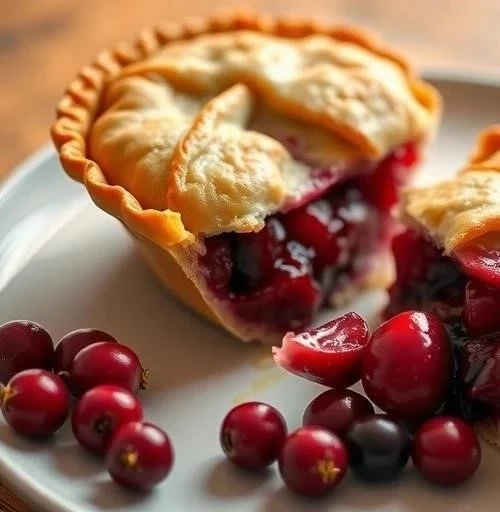
Some pies arrive at the table like polite guests. Lingonberry pies arrive like a winter story: bright, tart, and carrying the scent of a warm kitchen through the coldest day. These small pastries pair a soft, buttery yeast dough with berries that pop like tiny red lanterns. They are lovely with tea, but the real pleasure begins earlier—when the dough rises beneath a towel and the kitchen starts to smell like home.
A berry with a lively spark
Lingonberries have a clean, refreshing tartness that keeps a sweet pastry from becoming heavy; Fresh berries are wonderful, but frozen ones work beautifully too; use them straight from the freezer so they release less juice while you fill the pies. If lingonberries are difficult to find, cranberries make a good substitute, though they may need a little extra sugar. The goal is not to hide the berry’s sharpness, but to give it a soft landing.

Ingredients
For the dough
- 500 g all-purpose flour, plus a little for kneading
- 250 ml warm milk, pleasantly warm rather than hot
- 7 g instant yeast, or 20 g fresh yeast
- 70 g sugar
- 1 egg, at room temperature
- 70 g soft butter
- 1/2 teaspoon salt
For the filling and finish
- 250 g lingonberries, fresh or frozen
- 90–120 g sugar, adjusted to taste
- 1 tablespoon cornstarch
- 1 teaspoon finely grated orange zest, optional
- 1 egg beaten with 1 tablespoon milk, for brushing
Make a dough with a little patience
Stir the yeast and a teaspoon of the sugar into the warm milk. Leave it for about five minutes, until the surface looks lightly foamy. In a large bowl, mix the flour, remaining sugar, and salt. Add the milk mixture and egg, then stir until a rough dough forms. Work in the soft butter a little at a time; Knead for 8–10 minutes, until the dough becomes smooth and elastic. It should feel soft and slightly tacky, not stiff; add flour sparingly, since too much can make the finished pies dry.
Place the dough in a lightly greased bowl, cover it, and leave it somewhere warm for about an hour, or until doubled in size. This is a good moment to make tea, clear the counter, or simply watch the dough slowly become more confident.
Give the filling its own small saucepan
Put the berries and sugar in a saucepan over medium heat. Stir gently as the berries warm and some begin to burst. Mix the cornstarch with a tablespoon of cold water, then stir it into the pan. Cook for another minute or two, until the juices thicken and look glossy. Stir in the orange zest, if using, and let the filling cool completely. This little pause matters: hot filling can melt the butter in the dough and make sealing difficult.
Prefer a more rustic, juicy center? Skip the saucepan. Toss the berries with sugar and cornstarch just before shaping. This method gives a fresher, more whole-berry bite, but be especially careful to pinch each seam closed.
Shape the pies like tiny envelopes
Turn the risen dough onto a lightly floured surface and divide it into 12–14 equal pieces. Roll each into a ball, cover, and let them rest for ten minutes. Flatten one ball into a circle about 10 cm across. Spoon a small mound of cooled filling into the middle, leaving a clear border. Bring the edges together and pinch firmly, then place the pie seam-side down on a lined baking tray. A modest spoonful is better than an ambitious one: overfilled pies tend to open in the oven and let their ruby centers escape.
For a playful finish, make a tiny snip in the top of each pie with clean scissors. The opening acts as a steam vent and gives every pastry a little red window. Cover the shaped pies and let them rise for 20–25 minutes while the oven heats to 190°C (375°F).
Bake until golden
Brush the pies gently with the egg-and-milk mixture. Bake for 15–20 minutes, until their tops are deep golden and the bottoms sound lightly firm when tapped. Ovens have different temperaments, so begin checking at 15 minutes. If a little berry juice escapes, do not worry; caramelized edges are a cook’s small bonus. Transfer the pies to a rack and let them cool for at least ten minutes. The filling stays very hot, even when the pastry seems ready to eat.
Serving, storing, and making them your own
Serve the pies warm with black tea, coffee, or a spoonful of thick yogurt. A dusting of powdered sugar looks like the first snow on a red-roofed village; For a fragrant variation, add cardamom to the dough, or combine lingonberries with a diced apple for a softer, fruitier center. Keep leftovers in a covered container at room temperature for one day, or refrigerate them for up to three days. Warm them briefly in a low oven to bring back their tender crust.
These pies are not meant to be perfectly identical. One may be plump, another slightly crooked; one may hide its berry heart, another reveal it through a little vent. That is part of their charm. Make a batch on a quiet afternoon, and the kitchen will fill with the bright, unmistakable promise of lingonberries wrapped in warm dough.

5 Comments. Оставить новый
There’s something lovely about a recipe that treats dough as a living thing rather than a checklist. The gentle cues—soft, tacky, elastic—make this feel welcoming to beginners and satisfying for anyone who likes to bake by feel.
A charming reminder that frozen fruit isn’t a culinary compromise; sometimes it’s simply summer saved for a snowy afternoon. The practical notes are clear, while the writing makes the whole process feel warmly unhurried.
The best recipes don’t just tell you what to do; they help you imagine the smell of the room. This one had me picturing orange zest, rising dough, and a little burst of berry brightness in every bite.
I appreciate how the recipe lets lingonberries remain bold instead of burying their tartness under sweetness. It reads like a quiet vote for contrast—and for the kind of baking that makes an ordinary day feel ceremonial.
This recipe makes patience feel like an ingredient you can measure: a little waiting, a little kneading, and suddenly the kitchen has its own weather. I especially love the image of tart berries tucked into soft dough—like small winter lanterns hidden in a blanket.