
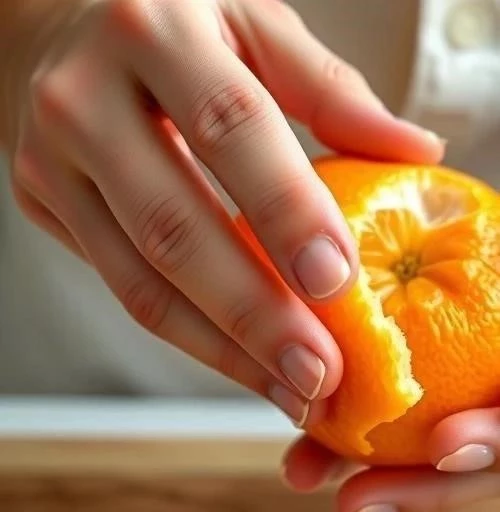
Peeling an orange without a knife is simple once you know where to start. A little patience helps you remove the skin in manageable pieces, while keeping the juicy fruit inside intact. The method works best with a ripe orange whose peel gives slightly when pressed.
Before you begin
Wash and dry your hands, then rinse the orange under running water and dry it with a clean towel. This removes dirt from the peel and makes the fruit less slippery. Choose a stable surface, such as a plate or countertop, in case a little juice escapes.
Check the fruit gently. A ripe orange usually feels firm but not hard, and its skin may have a small amount of give. Avoid squeezing it forcefully: too much pressure can bruise the fruit or split the peel before you are ready.
Step-by-step instructions
- Find the starting point. Hold the orange in one hand and look for the small dimple at the top, where the stem was attached. This area often has looser skin. You can also begin at the opposite end, where there may be a shallow indentation.
- Make a small opening. Press the tip of your thumb gently into the peel near the dimple. Push through the skin, not deeply into the orange. If the peel feels tough, rotate the fruit and try a nearby spot rather than forcing your nail.
- Lift the peel. Once your thumb is under the skin, ease it outward to create a flap. Keep the other fingers around the orange to support it, using light pressure. The aim is to separate the peel from the white pith, not to dig into the flesh.
- Work around the fruit. Pull away a small section at a time. Turn the orange as you go, sliding your thumb beneath the peel and loosening it gradually. If a strip tears, simply find another edge and continue. There is no need to remove the skin in one perfect piece.
- Clear the remaining bits. When most of the peel is off, pick away any stubborn patches and remove loose strands of white pith if you prefer. Separate the orange into its natural segments, then check for seeds before eating.
Helpful tips
If the peel is especially firm, roll the orange gently on the countertop for several seconds before peeling. Use your palm and moderate pressure; do not crush or flatten the fruit. This can loosen the skin and make the first opening easier. A warm orange may also peel more readily than one taken straight from a cold refrigerator, but never heat it until it is hot.
Keep your fingernails clean, and avoid using sharp objects if you specifically want to open the fruit by hand. If you have a hangnail or sensitive skin, press with the pad of your thumb instead of scraping with the nail. Children should peel fruit with an adult nearby, especially if they have difficulty making the initial opening.
Common problems
The peel breaks into tiny pieces: This is normal with some varieties. Make a fresh opening and remove several small sections rather than pulling harder. Juice starts to run: You may have pressed into the flesh. Ease your grip and continue more slowly over a plate. The first hole is difficult: Try the opposite end or a softer spot near the stem.
Enjoy and clean up
Eat the segments soon after peeling for the freshest flavor. Put the peel in compost or dispose of it, and wash your hands and the surface if juice or peel residue remains. With a gentle grip and a small starting opening, most oranges can be peeled neatly in under a minute;

9 Comments. Оставить новый
Clear and practical advice. I appreciate that it explains what to do if the peel tears instead of making the process sound perfect.
A concise and handy guide. It makes clear that patience matters more than trying to remove the peel in one piece.
The gentle, step-by-step instructions make peeling an orange feel much easier. I especially like the reminder not to press too hard.
The tips are straightforward and reassuring, especially for people who find orange peeling messy or difficult.
The instructions are easy to follow, and the reminder to wash and dry the fruit is a nice touch.
A helpful explanation that keeps the method simple and safe. I will try starting at the small dimple next time.
Good practical details, from picking a stable surface to gently removing stubborn bits of peel. Easy to use right away.
A useful guide for anyone who does not have a knife handy. The tips about choosing a ripe orange and starting near the stem are helpful.
I learned a simple way to loosen the peel without damaging the orange. The advice to work around the fruit a little at a time makes sense.