
A strip foundation supports the walls continuously, but it is not immune to movement, moisture or poor workmanship. Small cracks in a strip foundation may be harmless shrinkage; widening cracks, displaced sections or doors that suddenly stick can signal a serious problem. The right response depends on the cause, so covering a crack before inspection is rarely a sound repair.
Why damage occurs
Common causes of foundation cracks include uneven settlement, weak or poorly compacted soil, excessive loads and errors during construction. A violation of pouring technology, inadequate curing, poor-quality concrete for a strip foundation or insufficient reinforcement can reduce strength. Water is another major factor: groundwater and leaking downpipes soften soil, while soil freezing and frost heave push shallow foundations upward. These forces can cause foundation settlement or deformation and, in turn, wall tilting.
Inspection before repair
Begin with a foundation inspection. Record each crack’s location, width and direction; photograph it and check whether it changes over several weeks. Look for bulging, gaps between walls and floors, damp patches and exterior grading that directs water toward the house; A structural engineer should assess growing, diagonal or through-wall cracks, sudden movement, or visible displacement. They can determine whether movement is active and whether the building is safe to occupy. Do not excavate beneath a loaded wall without a designed sequence of work.
Choosing an effective solution
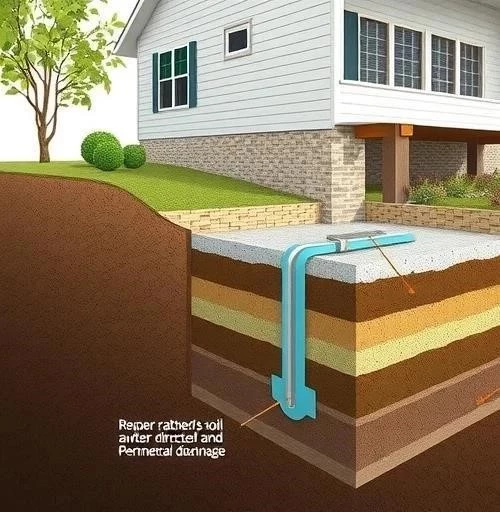
If movement has stopped and the damage is superficial, concrete restoration may involve removing loose material and crack sealing with a compatible repair mortar. Crack injection with resin or cement grout can suit certain stable cracks, but it does not correct settlement or eliminate water pressure. For active movement, first address the cause. Water drainage away from the foundation may require repaired gutters, grading and an effective house perimeter apron. Where site conditions warrant it, perimeter drainage can lower water around the building; foundation waterproofing protects the exterior surface but is not a substitute for drainage.
For structural damage, strip foundation repair may involve underpinning, a reinforced concrete jacket or reinforcement with steel. Foundation strengthening must be engineered to transfer loads safely; adding bars or concrete without design can make stresses worse. Repairs should be staged so that excavation does not destabilize the house base. The chosen method depends on soil, loads, access and the condition of the existing concrete.
Prevention and cost
Damage prevention starts before construction: investigate the soil, select suitable concrete, design adequate foundation reinforcement, follow the specified pouring and curing process, and keep roof water away from the building. Maintain the apron, gutters and drains, and inspect the structure after leaks or unusual ground movement. These measures reduce risk but cannot guarantee that settlement will never occur.
DIY foundation repair is reasonable only for minor, stable surface defects after the cause is understood. Do not fill a moving crack and assume the problem is solved. Repair cost varies with access, soil conditions, drainage work and structural strengthening; obtain a written scope and compare proposals that address the cause, not merely the visible crack. Prompt diagnosis is usually safer and less expensive than delaying repairs.



9 Comments. Оставить новый
The article avoids treating every crack as an emergency while still identifying warning signs such as widening, displacement and sudden changes in doors. That balanced approach can help readers respond promptly without jumping to conclusions.
Its discussion of drainage is especially valuable because water around a foundation is often overlooked. Checking gutters and grading is a sensible preventive measure, while more substantial drainage work should be planned to suit site conditions.
I appreciate that the article connects foundation damage to multiple possible causes, including soil conditions, construction quality and water. This helps explain why choosing a repair before identifying the cause can lead to recurring problems.
This is a practical overview of inspection and repair decisions. It would be useful to readers because it encourages them to distinguish cosmetic damage from active movement and to seek qualified help when structural safety may be involved.
The article makes a useful distinction between minor, stable cracks and signs that may indicate ongoing structural movement. Its emphasis on documenting changes over time is practical, since a single observation may not reveal whether a crack is worsening.
The guidance on recording crack width, location and direction gives homeowners a clear first step. Photographs and repeated measurements can make an inspection more informative, although they should not replace professional assessment of serious symptoms.
The explanation of frost heave and soil softening adds helpful context to the repair advice. It shows why a foundation problem may be caused by changing ground conditions rather than by the visible crack alone.
The safety warning about excavating beneath a loaded wall is important. Foundation repairs can involve serious structural risks, so the recommendation to consult an engineer when movement is visible or increasing is well judged.
The article correctly notes that crack injection is not a universal fix. Sealing may address a suitable stable crack, but it cannot resolve settlement or water pressure, so the underlying cause needs attention first.