
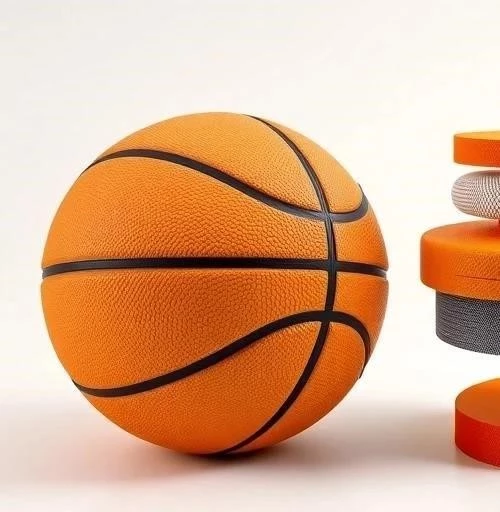
A basketball looks simple, but it is a layered piece of equipment. Its materials must help it keep its shape, bounce predictably, feel comfortable in the hand, and withstand repeated impact. The exact construction varies by model, playing surface, and price, but most balls share the same basic parts: an inner bladder, reinforcing layers, and an outer cover.
The inner bladder
At the center is an airtight bladder that holds the ball’s air. It is commonly made from butyl rubber, which retains air well and needs less frequent inflation than many alternatives. Some balls use a latex bladder, valued for its lively feel and responsiveness, although it may lose air more quickly. A small valve, usually made with rubber or synthetic materials, lets a pump needle enter so the ball can be inflated.
Winding and reinforcement
Wrapped around the bladder is a winding, often made from nylon or polyester thread. These fibers help the ball keep its round shape and resist stretching as it is inflated and used. The winding also helps the ball withstand the force of dribbling, passing, and shooting. Between the bladder and cover, manufacturers may add rubber or other backing layers to support the panels and improve durability.
The outer cover
The cover is the part players touch. It is divided into panels, with channels between them that provide grip and help guide the fingers. The panels are joined or molded around the inner structure, depending on the manufacturing method.
- Leather: High-quality genuine leather is traditionally used for indoor competition balls. It offers a soft, responsive feel, but usually needs to be broken in and is not suited to rough outdoor courts.
- Composite leather: This synthetic material is designed to imitate leather. It can offer good grip and a softer feel, and is common in indoor or indoor-outdoor balls.
- Rubber: Rubber covers are tough and generally affordable. They are often chosen for outdoor play because they stand up well to abrasive asphalt and concrete, though the feel may be firmer.
How the materials work together
No single material determines how a ball plays. The bladder affects air retention and bounce; the winding helps preserve shape; and the cover influences grip, softness, and wear. Panel texture and channel depth also matter. A ball intended for a polished indoor floor can use a softer cover, while an outdoor model needs a tougher surface. Many balls are marked for a particular setting, so checking the label is useful.
From materials to finished ball
During production, the bladder is fitted with its valve, inflated, and wrapped with reinforcing thread. Backing and cover panels are then applied, molded, or bonded around it. The finished ball is checked for size, weight, roundness, air retention, and rebound. These checks help ensure that it behaves consistently in play.
In short, a basketball is not simply a hollow rubber sphere. It is a carefully assembled combination of an air-holding bladder, strong fiber winding, supporting layers, and a cover selected for the court and the player. Choosing the right construction can make the ball more comfortable, durable, and reliable.
9 Comments. Оставить новый
A useful overview for anyone choosing a basketball. The comparison of leather, composite leather, and rubber gives readers practical context.
The article makes the different materials easy to understand and explains how they affect feel, durability, and air retention.
This article provides a solid foundation for understanding basketball materials and how construction can vary by model and court type.
This is a clear, helpful explanation of how a basketball is built. I especially liked the distinction between the bladder, reinforcement, and outer cover.
I appreciate that the article explains both what each layer is made of and why it matters during play.
The simple structure and clear headings make this easy to follow. I learned more about the winding and reinforcement than I expected.
The section on the inner bladder was particularly informative. It clearly describes the trade-off between air retention and responsiveness.
This is an accessible introduction to basketball construction, with useful details about how the ball’s materials suit different playing surfaces.
A concise and informative guide. The explanations connect the ball’s construction to the grip, bounce, and durability players notice.