
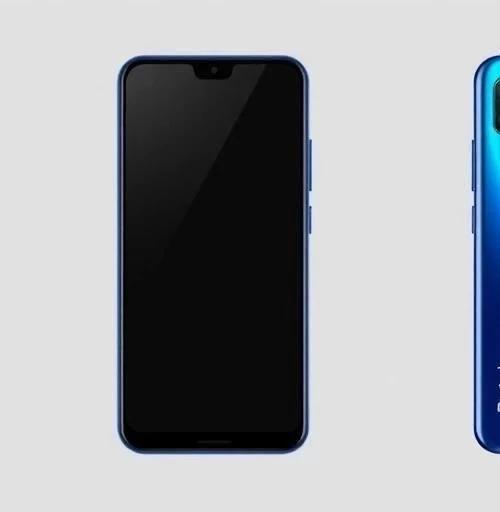
The Xiaomi Redmi 7 is a budget smartphone introduced in 2019. Its appearance follows the design language common to phones of that period: a large screen with a small notch, rounded corners, narrow side borders and a glossy, colorful back. The body is made primarily of plastic, rather than metal or glass, giving the phone a practical finish while keeping its weight relatively low.
Front view
The front is dominated by a 6;26-inch display with an aspect ratio of 19:9. The screen has rounded corners and a teardrop-shaped notch, sometimes described as a “dot drop” notch. It sits in the center of the upper edge and houses the front-facing camera. A narrow earpiece is positioned just above it.
There are visible borders around the display, with a somewhat wider strip below the screen than along the sides. The lower bezel carries the Redmi name on some versions, though the exact branding can vary by market. The screen is flat rather than curved over the edges, so the outline of the display remains easy to distinguish from the frame.
Viewed from the front, the Redmi 7 has a simple, symmetrical layout. There are no physical navigation buttons beneath the display; navigation is handled on screen. The rounded corners soften the rectangular shape, while the notch creates a small interruption in the top edge of the image.
Back and camera layout
The rear panel is one of the phone’s most noticeable visual features. It has a glossy, reflective surface and a gradient effect on selected color versions. Depending on the finish and the light, the back can appear brighter near one edge and darker near another. This gives the plastic panel a more decorative look than a plain, single-color surface.
Color options included Comet Blue, Lunar Red and Eclipse Black, although availability and naming could differ between markets. Blue and red versions emphasize the gradient more clearly; the black model has a more restrained appearance. Reflections can make the finish look different indoors, outdoors or when the phone is tilted.
A vertical dual-camera unit is placed near the upper-left corner of the back. The lenses sit one above the other, with a flash nearby. The camera area forms a small raised section, so it may not sit completely flush on a flat surface. The central part of the rear panel has a fingerprint reader, identifiable by its circular outline.
Branding and regulatory markings appear toward the lower portion of the back. Their exact placement and size may differ slightly among regional versions. Overall, the rear is visually busier near the top, where the cameras are grouped, while the fingerprint reader and lower branding are spaced farther apart.
Shape, size and controls
The Redmi 7 measures approximately 158.7 × 75.6 × 8.5 mm and weighs about 180 g. Its broad, rounded body is designed to fit a large display, but it is not a compact phone by current standards. The curved edges of the rear cover help the device sit more comfortably in the hand than a completely flat-sided slab of the same width.
The frame is plastic and follows the contour of the back. The volume rocker and power button are on the right side. A SIM and memory-card tray is on the opposite side. On the top edge are the headphone jack and infrared emitter; the bottom edge contains the charging connector and speaker openings. Exact details can vary by version, so a particular model should be checked before buying accessories.
The charging port is Micro-USB, an older connector that has a distinct, non-reversible shape. The 3.5 mm headphone socket is useful for wired headphones. These ports contribute to the Redmi 7’s familiar, functional appearance rather than giving it the minimalist look of phones that omit them.
Overall impression
At a glance, the Xiaomi Redmi 7 looks like a conventional 2019 entry-level smartphone: a large notched screen at the front, a glossy gradient-style back, a centrally placed fingerprint sensor and a vertically arranged dual camera. Its rounded plastic body and bright color choices make the design approachable, while the bezels and Micro-USB connector mark it as an older generation of device.
For identification, the most useful visual cues are the teardrop notch, circular rear fingerprint reader and camera module in the upper-left corner. Color and branding are less reliable clues because regional editions may differ. A photograph may also make the back appear more or less reflective depending on lighting.

3 Comments. Оставить новый
The descriptions of the notch, bezels, and color finishes make the phone’s appearance easy to visualize. The discussion remains focused on design.
The article is organized into relevant sections and notes that some branding and color details may vary by market. The screen measurement appears to contain a punctuation typo.
The article gives a clear overview of the Redmi 7’s exterior design, with useful distinctions between the front display and rear panel.