
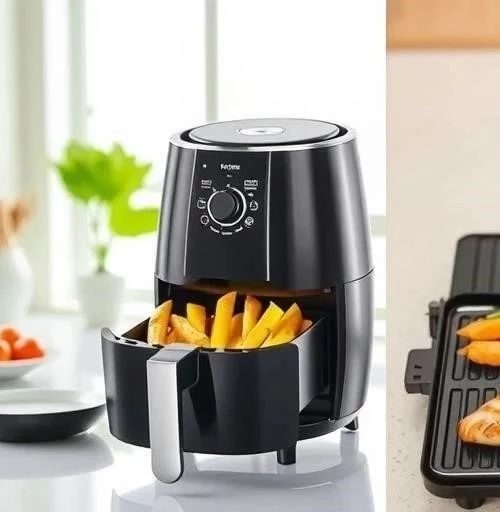
Air fryers and electric grills both cook food with electricity and can produce a browned, appetizing result. However, they work in different ways, so they suit different meals and cooking habits. The names can also be confusing: in some markets, an “air grill” is a countertop convection oven, while an electric grill usually has a heated cooking plate or grate. Here, air fryer means a compact appliance that cooks by circulating hot air.
How each appliance cooks
An air fryer heats air and moves it rapidly around the food with a fan. The food sits in a perforated basket or on a rack, allowing hot air to reach its surface from several directions. A heating element and thermostat regulate the temperature; many models also offer preset programs. This method is a small-scale form of convection cooking, rather than deep-frying.
An electric grill heats a metal plate, ridged surface, or grate. Food cooks mainly through direct contact with that hot surface, and, on open-grill models, through radiant heat. Contact grills close over the food from above, while open models typically heat from below. The heated ridges can create grill marks, and fat may drain into a tray.
Differences in the cooking result
- Texture: Air fryers are especially good at crisping the outside of foods such as potatoes, breaded vegetables, and chicken wings. Electric grills give food seared contact marks and a grilled surface. Neither automatically makes food taste exactly like it was cooked over charcoal.
- Best uses: An air fryer is versatile for reheating leftovers, roasting vegetables, baking small portions, and cooking frozen snacks. A grill is a natural choice for steaks, burgers, fish fillets, sandwiches, and vegetables that benefit from direct searing.
- Oil: Air frying usually needs little or no added oil, although a light coating can improve browning. A grill also needs little oil when its surface is properly coated, but marinades and fats can smoke or drip, depending on the model.
- Capacity: Air-fryer baskets have a stated volume, but food often needs to sit in a single layer for even crisping. Grill capacity is better judged by the size of its cooking surface. A large piece may fit on one appliance but not the other.
- Attention: Air fryers generally require occasional shaking or turning, especially when the basket is full. A contact grill can cook both sides at once; an open grill usually requires flipping food manually.
Convenience, cleaning, and limitations
Air fryers are often easy to operate: choose a temperature and time, then check or shake the food as needed. Their baskets and trays are removable, although grease and baked-on crumbs still need cleaning. Crowding the basket can block airflow, leading to uneven cooking, and a small appliance may require several batches for a family meal.
Electric grills can cook quickly because food touches a hot plate, and contact models can be convenient for sandwiches or thin cuts. Their drawbacks include smoke from dripping fat, splashes, and the need to clean ridges or a fixed cooking surface. Open grills also need a little more supervision. Cooking results depend on thickness, preheating, and how well the appliance maintains heat.
Neither appliance is automatically healthier in every situation. Both can help reduce the need for added fat, but the ingredients, portion size, and cooking temperature matter too. For either device, follow the manufacturer’s instructions, avoid overcrowding, and make sure meat reaches a safe internal temperature.
Which one should you choose?
Choose an air fryer if you want one compact appliance for crisping, roasting, reheating, and cooking small portions with circulating hot air. Choose an electric grill if seared surfaces, grill marks, burgers, steaks, or toasted sandwiches are your priority. If you cook both kinds of food regularly, compare available counter space, usable cooking area, temperature controls, removable parts, and cleaning requirements before buying.
In short: an air fryer cooks by circulating hot air around food; an electric grill cooks mainly by applying heat through a hot plate or grate. They can overlap in what they prepare, but they do not produce identical textures or offer the same strengths.



3 Comments. Оставить новый
This is a balanced overview that avoids claiming either appliance is best for everything. A short comparison of capacity and cleanup would make it even more useful.
I appreciate the note that an air fryer is not actually deep-frying. The distinction between circulating hot air and direct contact with a grill surface is useful when choosing an appliance.
The clear explanation of how each appliance cooks makes the comparison easy to follow. The practical examples of foods suited to each one are especially helpful.