
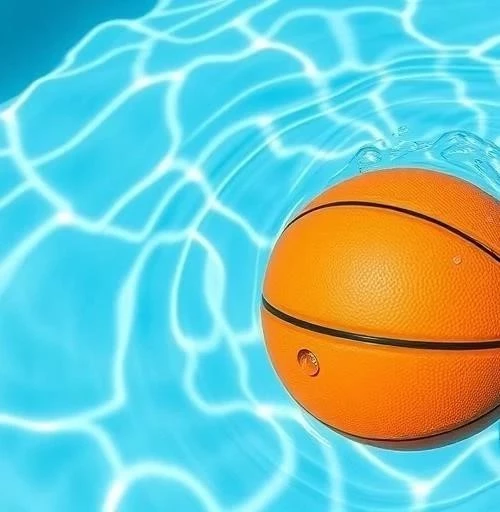
Short answer: You can briefly put a basketball underwater, but it is not designed to be submerged. A quick dunk to retrieve it is usually less concerning than leaving it underwater or repeatedly using it in a pool. For the ball’s condition and performance, keep it dry whenever possible.
What can happen?
A basketball’s cover, seams, and inner bladder are made to withstand normal play, not prolonged soaking. Water may seep through seams, the inflation valve, or small areas of damage. The outer material can absorb moisture, become slick, and feel different in your hands. A wet ball may also be harder to control, and its bounce can be less predictable while it is damp.
The effect depends on the ball. Leather balls are particularly sensitive to moisture and can become rough, stiff, or damaged as they dry. Composite and rubber balls generally cope better with occasional splashes, but they are not necessarily waterproof. Even if the outside seems dry, moisture may remain in seams or inside the ball.
If it gets submerged
- Take it out of the water promptly. Do not leave it soaking or use it for a long pool session.
- Wipe the surface with a clean, dry towel. Press gently around the seams and valve; do not squeeze or twist the ball.
- Let it air-dry at room temperature in a ventilated place. Rotate it occasionally so all sides can dry.
- Keep it away from radiators, hair dryers, direct heat, and strong sunlight. Rapid heating can harm the cover or materials.
- Once it is completely dry, check its feel and bounce. Inflate it only if needed, following the pressure printed on the ball or its manufacturer’s instructions.
Can you play with it in water?
It is better not to. Water makes the surface slippery, so the ball may be difficult to grip, pass, or shoot. That can spoil play and increase the chance of losing control. Pool chemicals, salt water, sand, and repeated wetting may also wear down the surface over time. A ball that has been underwater should not be used until it is dry enough to handle safely.
Bottom line
A brief accidental dunk will not automatically ruin every basketball, especially a rubber or outdoor model. Still, submerging one is unnecessary and can shorten its useful life. If you expect to play near water, choose a durable ball and follow its care label. When in doubt, check the manufacturer’s guidance: materials and water resistance vary by model.
5 Comments. Оставить новый
I like that this distinguishes a quick dunk from prolonged soaking and explains why a wet ball can be difficult to handle.
Helpful explanation of how different ball materials respond to water. The drying steps are easy to follow.
Straightforward and informative, with sensible steps to take if a basketball gets submerged. The material-specific note is a nice touch.
This is a clear, practical guide. I especially appreciate the advice to let the ball air-dry away from direct heat.
A useful reminder that even rubber and composite basketballs are not necessarily waterproof. Good advice for protecting the ball.