
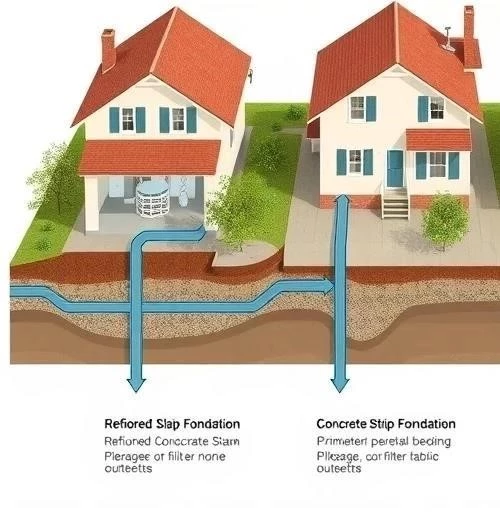
A reliable foundation for a house with an attic must support the whole building and manage water around it. An attic adds weight and may change how loads are distributed, so the choice should follow a load calculation that includes the weight of the attic floor, roof, walls, finishes and snow. No foundation type is best for every site: soil bearing capacity, soil type, groundwater level and frost depth all matter. Geological surveys are therefore a sound first step, not an optional extra.
Comparing foundation types
A strip foundation is a practical option for many houses on stable ground. It can be shallow where soil conditions and frost protection allow, or a deep foundation where weak layers or design loads require it. A slab foundation, usually a monolithic slab, spreads loads over a wide area and can suit weaker or uneven soils, though it may cost more in concrete and reinforcement. A pile-and-grillage foundation transfers loads to deeper, stronger layers; screw piles can shorten installation time, but need a design suited to the soil and corrosion conditions. A column foundation may work for a light building on firm, uniform ground, but is less suitable where settlement could vary.
Drainage and moisture protection
Drainage does not replace a properly designed foundation or waterproofing. Site water drainage should direct rain away from the building through grading, gutters and a storm sewer. Depending on the water conditions, a system may include wall drainage beside the foundation, ring drainage around the house, or deep drainage to lower groundwater. A perforated drainage pipe is commonly laid in gravel bedding, wrapped in geotextile, and connected to an inspection well for maintenance. The design must provide a safe outlet; otherwise, the system may collect water without removing it.
Foundation waterproofing protects concrete from moisture, while basement insulation and an insulated blind area can reduce heat loss and help limit frost effects. A drainage system should be coordinated with waterproofing, backfill and the planned finished ground level. On a wet or flood-prone site, these measures improve flood protection, but their effectiveness depends on correct installation and upkeep. A specialist should determine whether wall, ring or deep drainage is necessary rather than adding components without a hydraulic plan.
Making the choice
Technology comparison should consider construction cost, installation time, access for machinery, maintenance and durability—not just the initial price. A slab may simplify floor construction; piles may reduce excavation; a strip system can be economical on suitable ground. Yet poor design can make any option costly to repair. The final foundation choice belongs in the house design, based on survey data, calculations and local codes. A planned drainage system, reliable materials and quality workmanship together support a durable structure.

5 Comments. Оставить новый
I appreciate the article’s attention to frost depth, settlement, and groundwater, since these factors are easy to overlook when comparing foundation costs. The practical examples make the technical considerations more accessible.
The comparison of strip, slab, pile-and-grillage, and column foundations is balanced and practical. It explains where each option may be suitable while avoiding the impression that any one type is automatically best.
The drainage section is particularly helpful because it distinguishes site drainage from foundation waterproofing. That clarification can prevent readers from assuming that a drainage system alone will protect a building from moisture.
The article makes a useful point that foundation choice should begin with the site and structural loads, rather than with a one-size-fits-all recommendation. Its emphasis on a geological survey helps readers understand why soil and groundwater conditions matter.
This is a clear overview for homeowners planning a house with an attic. The reminder that drainage needs a safe outlet is especially valuable, as a system that cannot discharge water may not solve the problem it was designed for.