
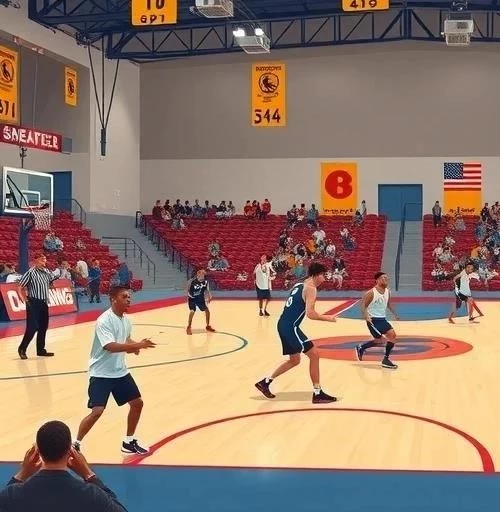
A basketball game’s playing time is much shorter than the time most spectators spend at the arena or watching a broadcast. The official duration depends on the competition’s rules, while stoppages, breaks and reviews extend the event. In practice, a professional game commonly takes about two to two and a half hours from tip-off to the final buzzer;
Official playing time
In the NBA, a game consists of four 12-minute quarters, giving 48 minutes of regulation playing time. Under FIBA rules, used in international competitions and many domestic leagues, there are four 10-minute quarters, for a total of 40 minutes. These figures refer to time on the game clock, not the full time required to watch the match.
Some college competitions use a different format. In NCAA men’s basketball, the game is divided into two 20-minute halves. NCAA women’s games generally have four 10-minute quarters. Rules vary between countries, age groups and tournaments, so it is useful to check the format of a particular event rather than assume every game lasts the same length.
Why the real duration is longer
The game clock usually stops when play is interrupted. Common causes include fouls, free throws, timeouts, substitutions, the ball going out of bounds and officials reviewing a decision. The clock also stops at the end of each quarter. Once play resumes, it starts again, so 40 or 48 minutes of official play can be spread across a considerably longer period.
Scheduled intervals add time as well. There are short breaks between quarters and a longer halftime interval. Teams may use timeouts to discuss tactics or stop the clock, and late-game fouls can lead to several free throws and further pauses. Television coverage may include additional commercial breaks. Video reviews can also extend a game, especially when officials need to examine a close or disputed play.
Overtime and possible delays
If the score is tied at the end of regulation, the teams play an overtime period. In the NBA and under FIBA rules, overtime lasts five minutes. If the score remains level, another overtime is played, and this continues until a winner is determined. Each extra period brings its own stoppages and interval, so a close game can last substantially longer than a typical one.
Delays do not always come from the clock. An injury, equipment issue or problem with the court can pause play. The length of a broadcast may also differ from the time spent inside the arena because television programmes often begin before tip-off and continue after the game ends.
Typical time to allow
- FIBA or most international games: commonly around two hours, though longer games are possible.
- NBA games: often about two to two and a half hours, with close contests sometimes taking longer.
- Games with overtime or extended reviews: allow extra time; there is no fixed maximum for the full event.
These are practical estimates, not guarantees. The pace of play, number of fouls, timeouts, reviews and overtime all affect the finish time. If attending in person, allow additional time for entry, security checks, finding a seat and leaving the venue. For a broadcast, the scheduled programme window may be longer than the game itself.
In brief
Basketball regulation time is usually 40 minutes under FIBA rules and 48 minutes in the NBA, but the clock stops frequently. As a result, the complete event typically lasts roughly two hours or more. Overtime, close finishes and lengthy interruptions can extend it further, so planning for at least two to two and a half hours is sensible for many professional games.
6 Comments. Оставить новый
The distinction between game-clock time and the full event length is presented in a straightforward way.
The article covers several common factors that affect a game’s overall duration, including timeouts and video reviews.
The comparison of NBA, FIBA and NCAA formats makes the differences in game rules easy to follow.
The section on different competition formats is helpful for readers comparing basketball games across leagues.
The article clearly distinguishes official playing time from the longer duration spectators can expect.
The explanation of clock stoppages gives useful context for why a basketball game often lasts much longer than its regulation time.