
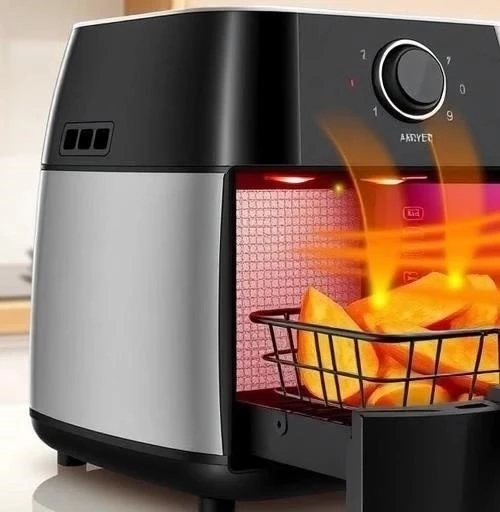
An air fryer is a compact countertop appliance that cooks food by circulating hot air rapidly around it․ Despite its name, it does not fry food in the traditional sense: conventional deep-frying immerses ingredients in hot oil, while an air fryer usually needs only a small amount of oil—or none at all․ Its design aims to produce a browned, crisp exterior with less added fat and less mess․
How the appliance works
Most air fryers contain a heating element and a fan․ The element heats the air, and the fan drives it around the cooking chamber at high speed․ A perforated basket lets this hot air reach food from several directions․ The combination of heat, airflow and a dry surface encourages browning and crisping, much as it does in a convection oven․
To use one, place food in the basket, set the temperature and cooking time, and start the appliance․ Shaking or turning the food partway through can help it cook evenly, especially when pieces overlap․ A light coating of oil can improve browning, but adding too much may cause smoke or leave food greasy․ The exact results depend on the model, the amount of food and how densely it is packed․
Why people choose one
The main advantage is convenience․ Air fryers generally heat quickly, need little preheating and are easy to use for small portions; They can crisp foods such as potatoes, vegetables and breaded items without a deep pan of oil․ Using less oil may reduce the fat in a meal compared with deep-frying, although it does not automatically make every recipe healthy: ingredients and portion sizes still matter․
There are trade-offs․ A small basket limits batch size, and crowded food may steam rather than crisp․ Cooking times can differ from those in a full-size oven, so checking food and following safe internal-temperature guidance is important․ An air fryer also cannot reproduce every quality of deep-fried food; the texture and flavor will not be identical․
Is it worth having?
An air fryer is most useful for people who often cook modest portions and value speed, crisp textures and straightforward cleanup․ It is less compelling for large family meals or for anyone expecting oil-free food to taste exactly like deep-fried food․ In short, it is best understood as a small, powerful convection cooker—not a magical fryer․ Used with realistic expectations, it can be a practical addition to a kitchen, but it complements rather than replaces an oven, stovetop or balanced cooking habits․
7 Comments. Оставить новый
This is a reasonable overview for someone deciding whether to buy an air fryer. It explains the convenience of cooking small portions while also acknowledging that basket capacity can be a drawback.
The explanation of the heating element, fan and perforated basket gives readers a useful picture of how the appliance operates. This makes the practical advice about airflow and avoiding overcrowding easier to understand.
The article clearly explains that an air fryer works by circulating hot air rather than immersing food in oil. The comparison with a convection oven helps readers understand both the appliance’s strengths and why its results are not identical to deep-frying.
The safety reminder about checking food and using appropriate internal temperatures is important. The article appropriately makes clear that convenience should not replace careful food preparation.
The instructions are easy to follow, especially the advice to shake or turn food partway through cooking. It is also helpful that the article notes cooking times vary by model and batch size.
I appreciate the balanced discussion of convenience and limitations. Mentioning that a crowded basket can prevent food from crisping gives readers a practical tip that may improve their results.
The article avoids presenting an air fryer as automatically healthy. Its reminder that ingredients and portion sizes still matter makes the discussion of reduced oil use more thoughtful and credible.