
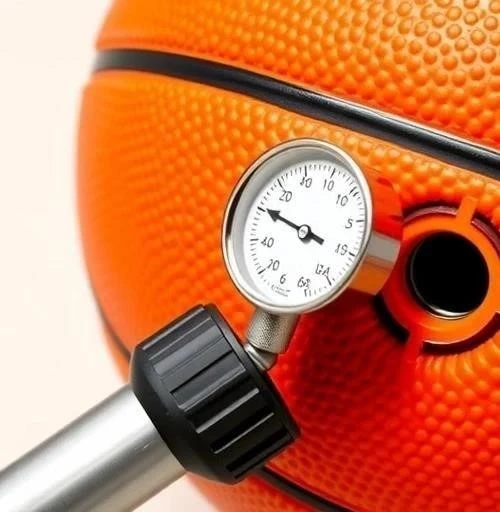
A basketball is usually inflated to about 0.55 atmosphere above the surrounding air pressure. In everyday terms, this is commonly described as roughly 0.5–0.6 atm. Many full-size basketballs use a recommended range of 7.5–8.5 psi, equivalent to approximately 0.52–0.58 atm of gauge pressure. The exact value depends on the ball, so the manufacturer’s instructions printed on it or its packaging should take priority.
Understanding the pressure measurement
Pressure gauges used for sports balls normally show gauge pressure: the pressure inside the ball compared with the air outside it. This is the number relevant when inflating a ball. It is not the same as absolute pressure, which includes the surrounding atmospheric pressure. For example, a gauge reading of about 0.55 atm corresponds to roughly 1.55 atm absolute at sea level.
This distinction explains why a reading of “0.55 atm” does not mean that the ball’s total internal pressure is lower than the air pressure around it. The air inside must be higher in pressure than the surroundings to keep the ball inflated and make it bounce. If a pump gauge is marked in psi, use the conversion 1 atm ≈ 14.7 psi. Thus, 8 psi is about 0.54 atm.
Why the correct inflation matters
A ball that is underinflated feels soft, may bounce inconsistently, and can be harder to control during passing and dribbling. A ball that is overinflated feels unusually hard, may rebound too high, and can be uncomfortable to handle; Excessive pressure can also put unnecessary strain on the ball’s seams, bladder, and valve. The goal is not to make the ball as hard as possible, but to reach the range specified for that particular model.
Indoor and outdoor basketballs generally use similar inflation pressure. Their covers differ because they are designed for different playing surfaces, but the appropriate pressure is determined by the manufacturer, not simply by whether the ball is used indoors or outside. Ball size alone does not provide a reliable pressure setting either: check the printed recommendation for the specific ball.
How to inflate and check a basketball
- Find the recommended pressure, often printed near the valve or on the ball’s label. Check whether the value is given in psi, kPa, or another unit.
- Use a pump with a pressure gauge; Moisten the inflation needle before inserting it, and push it carefully into the valve to avoid damaging the bladder.
- Add air gradually, checking the gauge as you go. Stop within the manufacturer’s stated range rather than continuing until the ball feels very hard.
- Remove the needle gently and check the ball’s feel and rebound. If the pressure is above the recommended value, release a little air and measure again.
A simple bounce check can help identify a problem, but it is less precise than a gauge. A basketball used in formal play is tested under specified conditions, including a measured drop onto a playing surface; the required rebound depends on the rules and ball specification. A casual hand bounce cannot reproduce that test exactly, so it should be treated only as a practical check, not as a substitute for a pressure reading.
Temperature, storage, and safety
Air pressure changes with temperature. A cold ball may show a lower reading and feel less lively; after warming up, its pressure can rise. For a consistent measurement, let the ball reach the temperature at which it will be used, then check it with a gauge. Avoid leaving an inflated ball in direct sunlight, inside a hot car, or near a heat source. Store it in a cool, dry place and inspect the valve and surface periodically.
In short: for many basketballs, approximately 7.5–8.5 psi, or 0.52–0.58 atm of gauge pressure, is a useful reference. The correct setting is the one specified by the manufacturer. Measure with a gauge, inflate gradually, and do not confuse gauge pressure with absolute pressure.


1 Comment. Оставить новый
The distinction between gauge and absolute pressure is clearly explained, and the practical guidance on checking the manufacturer’s recommended range is useful.