
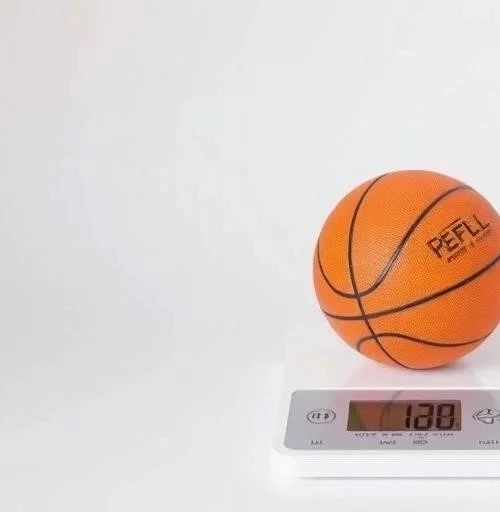
A regulation basketball usually weighs between 510 and 650 grams (about 1.1–1.4 pounds), depending mainly on its size and the rules it is made to meet. For a standard men’s game, the familiar full-size ball weighs roughly 600–625 grams, or around 1.3–1.4 pounds. The exact figure can vary slightly between leagues and manufacturers.
Weight by ball size
Basketballs are made in several sizes so players can use a ball suited to their age group and competition. The labels and precise specifications can differ somewhat by governing body, but these ranges are useful general guides:
- Size 7: The standard full-size ball used in men’s adult basketball. It is commonly about 600–650 grams (1.32–1.43 pounds). NBA specifications call for a ball weighing about 22 ounces, which is approximately 624 grams.
- Size 6: Commonly used in women’s adult basketball and by many younger players. It generally weighs around 510–567 grams (1.12–1.25 pounds).
- Size 5: A youth ball, often weighing about 470–500 grams (1.04–1.10 pounds), though specifications vary.
- Smaller junior sizes: These are lighter still and are designed for children who may find a full-size ball difficult to handle.
These figures are practical approximations, not a promise that every ball carrying the same size label will have identical weight. For an official game, check the rules of the relevant league and the product’s specifications.
Why does the weight matter?
Weight affects how a ball feels when a player dribbles, passes, shoots, or catches it. A heavier ball may feel more substantial and require greater force to move. A lighter ball can be easier for a young player to control, but it may not feel like the ball used in competition. Training with the correct size helps players develop more consistent technique and touch.
Weight is only one part of how a basketball behaves. Its circumference, surface texture, construction, and inflation pressure also influence grip and bounce. Two balls with similar weight can therefore feel noticeably different in the hands or on the court.
What can change a ball’s measured weight?
Manufacturing tolerances mean that two new balls of the same model may not weigh exactly alike. Materials and construction also matter: indoor balls, outdoor balls, and composite or rubber models can differ. Dirt, moisture, or a wet surface may add a small amount of weight, while wear can change a ball’s condition over time.
Air pressure is important for performance, but it does not meaningfully alter the ball’s mass. Inflation changes how firm and lively the ball feels; it does not turn a size 7 ball into a different weight category. Follow the pressure range printed on the ball or supplied by its manufacturer rather than guessing by feel alone.
How to check a basketball’s weight
Use a kitchen or parcel scale that can measure in grams. Place the dry ball gently on the scale and wait for the reading to settle. If you are checking whether it is suitable for a particular competition, compare the result with that organization’s official specifications. A household measurement is helpful for a quick check, but it cannot replace formal equipment inspection.
Mass and “weight”
In everyday speech, people ask how much a basketball “weighs” and expect an answer in grams or pounds. Strictly speaking, grams measure mass, while weight in physics is the force of gravity on an object and is measured in newtons. On Earth, the distinction rarely affects a practical comparison: when someone says a basketball weighs about 624 grams, they mean its mass is about 624 grams.
Quick answer
A typical adult basketball weighs around 600–625 grams (about 1.3–1.4 pounds). A size 7 men’s ball is generally heavier than a size 6 women’s ball or a youth ball. Always check the size and league rules when an exact official weight matters.


7 Comments. Оставить новый
The explanation of why weight matters for dribbling and shooting adds useful context beyond just listing numbers.
Well organized and practical. I especially liked the note that circumference, texture, and inflation also affect how a ball feels.
This is a convenient guide for choosing a basketball for different age groups. The approximate ranges are easy to understand.
A clear and helpful overview. The size-by-size weight ranges make it easy to find the information you need.
Concise and informative, with helpful conversions between grams, ounces, and pounds. The league-specific caveat is important too.
I appreciate the reminder that ball weight can vary between manufacturers and leagues. Checking the product specifications is good advice.
A useful summary for anyone comparing basketball sizes. It clearly distinguishes the standard adult ball from lighter youth options.