
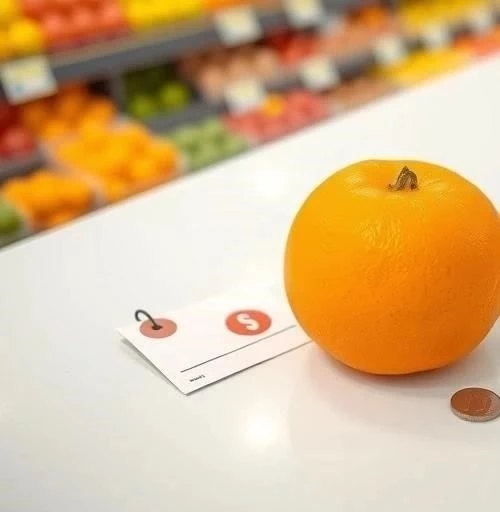
Short answer: there is no single fixed price for one orange in Russia. The amount depends on the city‚ shop‚ season‚ orange variety‚ size‚ country of origin‚ and whether the fruit is sold loose or in a net. To find the price of one orange‚ check the price per kilogram and weigh the fruit—or divide the package price by the number of oranges.
How to calculate the price of one orange
Most shops display oranges by weight‚ with a price per kilogram. One kilogram contains a varying number of fruits: small oranges weigh less than large ones‚ and varieties differ. A practical estimate is to assume that an ordinary orange weighs about 150–220 grams. That means roughly five to seven oranges may make up a kilogram‚ although the exact count can be outside that range.
Use this simple formula:
Price of one orange = price per kilogram × weight of the orange in kilograms.
For example‚ if oranges cost 180 rubles per kilogram and a particular orange weighs 200 grams‚ its estimated price is 180 × 0.2 = 36 rubles. If the same fruit weighs 160 grams‚ it costs about 29 rubles. These figures illustrate the calculation; they are not a verified current offer from a particular retailer.
Why the amount varies
- Location: prices can differ between regions and even between neighbourhood stores. Transport distance‚ local supply‚ and competition all influence the shelf price.
- Season and supply: harvest timing‚ weather‚ shipping‚ and import availability can change wholesale costs. Retail prices may rise or fall as those costs and stocks change.
- Size and variety: a large orange usually costs more per fruit simply because it weighs more. Premium varieties or fruit selected for appearance may also have a higher price per kilogram.
- Retailer and format: a market stall‚ supermarket‚ convenience shop‚ and online grocery service may charge different amounts. A promotion can make a bag cheaper than buying the same fruit individually.
- Quality and condition: freshness‚ visible damage‚ and grading affect what a seller offers. Discounted fruit may be perfectly suitable to eat‚ but check it before buying.
Quick examples
The table below shows how weight changes the cost at different hypothetical per-kilogram prices. It is provided for arithmetic‚ not as a live price list.
| Price per kg | 150 g orange | 200 g orange | 250 g orange |
|---|---|---|---|
| 120 rubles | 18 rubles | 24 rubles | 30 rubles |
| 180 rubles | 27 rubles | 36 rubles | 45 rubles |
| 240 rubles | 36 rubles | 48 rubles | 60 rubles |
The calculation is proportional: doubling the weight doubles the cost at the same per-kilogram rate. If a shelf label quotes a price for a net rather than for a kilogram‚ divide the total by the number of fruits to get an average per orange. Individual pieces in the net may still vary in size.
How to check the current price
For an accurate amount‚ look at the price tag in the shop or the product listing in the retailer’s app on the day you plan to buy. Confirm whether the listing is priced per kilogram‚ per piece‚ or per package‚ and check whether the shown price requires a loyalty card or applies only during a promotion. Online listings can also vary by delivery address and available stock.
If you are in the store‚ place one orange on the produce scale and use the displayed weight with the per-kilogram price. If the scale prints a label‚ it will usually show the charge for that fruit. This is more reliable than estimating from the number of oranges in a kilogram‚ especially when the fruit is unusually small or large.
What does “one orange costs” mean?
There is a difference between a fruit’s approximate individual cost and its actual checkout price. When fruit is weighed‚ the customer pays for its measured weight‚ so two oranges with the same shelf price per kilogram can have different individual prices. Rounding rules‚ packaging‚ and store promotions may affect the final total as well.
Also distinguish the shelf price from the broader cost of bringing the fruit to market. In everyday shopping‚ the useful figure is the amount the retailer charges. It is not necessarily the same as the supplier’s cost or a general market average.
Bottom line
One orange may cost only a few dozen rubles in an illustrative calculation‚ but the exact answer depends on its weight and the current local price per kilogram. As a quick estimate‚ multiply the kilogram price by 0.15–0.22 for a typical 150–220 gram orange. For the precise amount‚ weigh the fruit and check the current label; without a location and a live store price‚ no exact ruble figure can be guaranteed.

9 Comments. Оставить новый
I like that the weight estimate is described as approximate, since oranges can vary quite a bit in size.
A practical guide for comparing loose oranges with bags or nets at the grocery store.
Concise and useful advice for checking whether a package deal is actually cheaper.
Mentioning location, season, and retailer gives a clear picture of the factors that can change prices.
The calculation makes it easy to estimate the cost of an orange when prices are listed per kilogram.
The simple formula is useful, especially for shoppers who want to work out the cost of one piece of fruit.
The examples are helpful, and it is good that they are clearly presented as illustrations rather than current store prices.
I appreciate the reminder that orange size affects the price per fruit, even when the price per kilogram stays the same.
The article explains well why there is no single price that applies everywhere in Russia.