
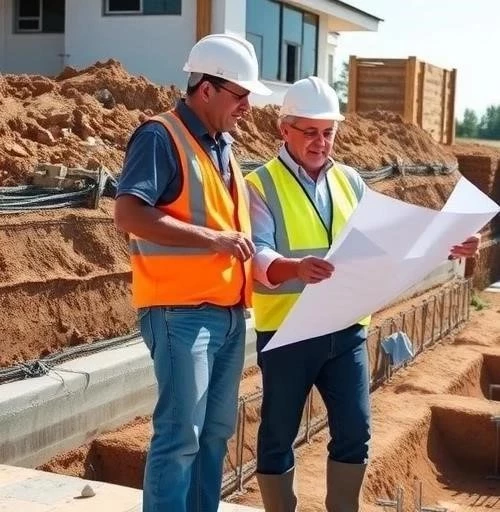
A foundation determines how safely a building carries its loads, so choosing a foundation contractor on the lowest quote alone is a poor strategy. Compare proven building experience, a project portfolio and customer reviews. Ask whether the company has relevant licenses and permits, who supervises the crew, and whether the same team will complete each stage. Clear answers are evidence of accountability; vague promises are a warning sign.
Check the design before comparing prices
Reliable strip foundation construction begins with a foundation design based on the building plan and load calculation. Geotechnical investigations and soil analysis help establish bearing capacity, groundwater conditions and the correct embedment depth. These findings affect excavation, concrete grade, reinforcement and drainage. If a contractor suggests a standard depth without checking the site, request a technical explanation before signing.
Ask for a written foundation estimate that lists the cost of work, building materials, quantities, exclusions and payment milestones. A price per linear meter is useful only when its scope is clear: it may or may not include site layout, earthworks, formwork, a rebar cage, concrete pouring, foundation waterproofing, foundation insulation or site drainage. Compare like-for-like estimates, not just headline totals.
Contract, schedule and quality
A construction contract should define the work stages, construction schedule, materials, responsibilities, change-order process and cleanup. It should identify who checks the reinforcement before pouring and how concrete delivery and placement are documented. Quality control and independent technical supervision reduce the risk of concealed errors. Agree on inspection points in advance, especially for excavation depth, the reinforcement cage and waterproofing.
Turnkey foundation installation can simplify coordination, but it does not remove the need for oversight. Confirm exactly what “turnkey” covers, who arranges tests, and how delays caused by weather or soil conditions are handled. The contractor should explain how deviations from the foundation design are approved, rather than making undocumented changes on site.
Acceptance and aftercare
At work acceptance, compare completed work with the contract and design; review delivery notes, test records and concealed-work photographs. Record concerns in writing before making final payment. A workmanship warranty should state its duration, coverage, exclusions and response procedure. Ask about warranty service and how suspected foundation defects will be inspected and remedied.
The best choice is not automatically the cheapest or the largest firm. Favor a contractor who supports claims with evidence, provides a transparent estimate and accepts measurable quality checks. A carefully selected team, sound design and documented process protect both the building and your budget long after construction ends.


8 Comments. Оставить новый
The article rightly connects quality control with work that may soon be hidden, particularly reinforcement and waterproofing. Agreeing on inspection points in advance seems like a sensible way to reduce disputes.
Overall, this is a practical checklist grounded in the technical and contractual risks of foundation construction. The advice encourages readers to ask for evidence and explanations, which is more reliable than choosing based on confident promises alone.
The section on contracts is valuable because it treats schedule, materials and change orders as essential parts of the project rather than paperwork. Defining these details should help both sides understand what is included.
The article makes a persuasive case for comparing contractors on more than price. Its emphasis on relevant experience, project examples and clear answers gives homeowners practical ways to assess accountability before committing.
I appreciate the explanation of why soil conditions and load calculations matter to foundation design. It helps readers understand that a standard depth is not a substitute for a site-specific technical assessment.
This is a clear overview of the questions a homeowner should ask before signing. The points about supervision, crew responsibilities and inspection stages make the guidance more actionable than general advice to “check references.”
The advice to compare written estimates with matching scopes is especially useful. Listing possible exclusions such as drainage or waterproofing can prevent a seemingly inexpensive quote from becoming costly later.
It is helpful that the article does not present turnkey service as a reason to stop monitoring the work. Clear boundaries for what the service covers are important, even when one company coordinates the full project.