
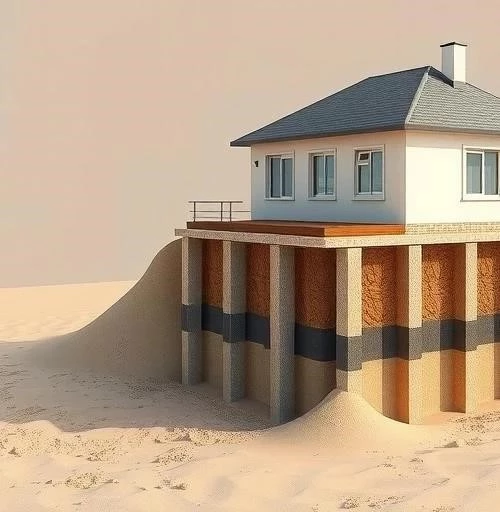
Sand looks simple: dry grains, firm footing, no muddy drama. Yet a sandy plot can behave like a shifting crowd—its strength depends on grain size, density, water and what lies beneath. Choose piles by evidence, not by the reassuring crunch under your boots.
Read the ground before choosing
Order geotechnical surveys, also called engineering-geological investigations, before design. Boreholes reveal soil layers, the groundwater level and whether loose sand hides a denser bearing stratum. The soil report should describe sand density and coarseness: coarse, dense sand usually carries loads better than fine, loose sand, though water and layering can change the picture; Check frost susceptibility too; clean sand is generally less frost-susceptible than silt, but wet, fine material may still move.
Match the pile type to the site
- Screw piles install quickly with limited excavation and can suit light buildings, but their blades need an appropriate soil layer and corrosion protection.
- Bored piles are formed in drilled holes and may work where vibration must be controlled. In loose, waterlogged sand, the hole can collapse, so casing or another stabilizing method may be required.
- Driven piles, including reinforced-concrete piles, are installed by impact or pressing. They can reach dependable dense layers, but noise, vibration and access for machinery must be considered.
No pile type wins everywhere. The right pile selection follows the soil profile, construction access, building weight and local requirements.
Calculate, don’t guess
A designer uses the soil’s bearing capacity and the building’s loads to calculate the pile foundation. The calculation checks compression, uplift and lateral forces, as well as settlement. It determines pile number, spacing, pile length and diameter, then verifies that groups of piles and the surrounding soil behave safely together. Pile embedment depth must reach a suitable layer; it is not simply “as deep as possible.” A longer pile may add cost without improving performance.
Include walls, floors, roof, snow, people and equipment in the load on the foundation. Do not copy a neighbour’s layout: a small change in soil or house plan can alter the required number of piles and their spacing.
Plan the connection and installation
Piles must work as a team. A grillage links their heads and distributes building loads; pile strapping or the structural tie connects the foundation to the frame. Detail this connection for the chosen wall material, and protect steel from corrosion where needed. During pile installation, record location, depth, verticality and installation resistance. Unexpected refusal or unusually easy penetration is a reason to investigate, not to improvise.
Compare cost and avoid costly shortcuts
The cost of a pile foundation includes surveys, design, piles, machinery, installation, corrosion protection, grillage and drainage where required. The cheapest quote may omit essential work. Common foundation mistakes include skipping geotechnical surveys, selecting piles by price alone, ignoring groundwater, using arbitrary spacing and assuming every sandy site is stable.
Follow applicable building codes and construction standards, and have the design checked by a qualified engineer. For a house foundation on a sandy plot, the reliable sequence is simple: investigate, calculate, select, install and inspect. Sand may seem like a blank canvas; good engineering turns it into a dependable place to build.


5 Comments. Оставить новый
I like how this turns an invisible problem into a practical investigation: the ground is treated less like a blank page and more like a witness whose layers have to be read. The reminder that “deeper” does not automatically mean “better” is especially valuable.
This reads like a calm conversation with an experienced engineer: practical, careful and refreshingly free of magic fixes. Its strongest message is that a sound foundation starts with asking the ground the right questions.
A thoughtful guide to making decisions with evidence rather than intuition. The image of loose sand behaving like a shifting crowd sticks with me—and neatly captures why soil layers, moisture and settlement deserve attention before construction begins.
The article gives foundation choices a welcome reality check. Each pile type comes with its own backstage crew of soil conditions, machinery and site constraints—a useful way to show why one-size-fits-all advice can wobble.
Clear and grounded without making the subject feel like a concrete wall of jargon. I especially appreciated the distinction between what sand looks like at the surface and what a proper investigation can reveal underneath.