
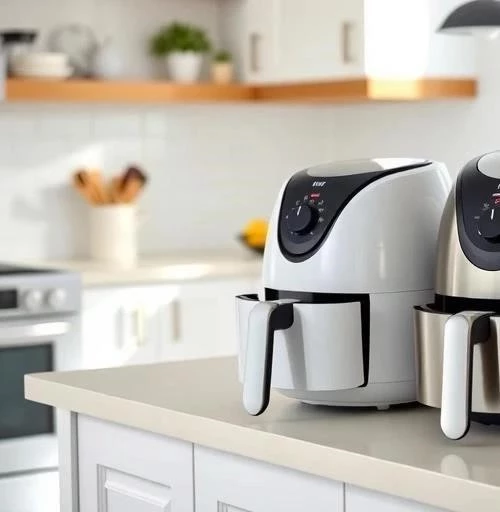
An air fryer is a tiny countertop weather system: it sends hot air swirling around dinner until potatoes turn crisp and yesterday’s leftovers get a second chance. But the right model isn’t necessarily the biggest, shiniest or most powerful. It’s the one that fits your kitchen, your household and the way you actually cook. Use this guide to find your match—not a gadget that hogs the counter and quietly gathers dust.
First, picture an ordinary Tuesday
Before comparing buttons, imagine the meal you’d make most often. A basket model is a natural choice for chips, vegetables, chicken pieces and quick snacks. Pull out the drawer, shake the food halfway through, and serve. It is usually compact and straightforward, which makes it appealing for one or two people and for cooks who value speed over ceremony.
An oven-style air fryer has a front door, shelves and often a larger cooking chamber. It can handle several foods at once, toast, reheat pizza or roast a small chicken, depending on the model. The trade-off is a larger footprint and, sometimes, more parts to clean. If you want one countertop appliance to play several roles, this format may earn its space.
Capacity: shop for appetites, not advertising
Capacity figures can be confusing: manufacturers may describe the whole chamber, while the usable basket is what matters at dinner time. A crowded basket blocks airflow and can leave food pale or uneven. A little breathing room between pieces is part of the recipe, so don’t assume a large number guarantees a large batch of crisp food.
- One or two people: a compact basket may be enough for everyday sides or a couple of portions.
- Three or four: look for a roomier basket or shelves, especially if you want to cook the main dish and vegetables together.
- Large households or batch cooking: consider a large oven-style unit, but check its real dimensions and whether your counter can accommodate it.
If dinner regularly means several hungry people, a smaller fryer may still work—but expect to cook in batches. Think about whether you’re happy to do that before buying.
Features worth paying attention to
Temperature and timer controls: Clear, adjustable settings are more useful than a long list of mysterious presets. Presets can be convenient starting points, but food thickness, quantity and starting temperature all affect cooking time. A timer you can adjust easily gives you more control.
Wattage: Higher power can help a fryer heat quickly, but it is not a promise of better results by itself. Check the appliance’s power against your kitchen’s outlets and electrical limits, particularly if you plan to run it alongside other high-power devices.
One basket or two: A dual-zone model can cook separate foods at different settings, and some can coordinate finishing times. That sounds like a weeknight superpower, but it takes more counter space and adds components. Choose it if you’ll regularly use both zones—not just because the feature looks futuristic.
Viewing window and interior light: These let you check browning without opening the drawer or door and releasing heat. They are pleasant conveniences, not essentials.
Cleaning: Removable, dishwasher-safe parts may save effort, but confirm what the manual actually allows. Non-stick coatings need gentle handling; avoid abrasive tools and follow the manufacturer’s care instructions. Ask yourself whether you can easily reach around the heating element and wipe the interior.
Measure the kitchen before the excitement
Write down the appliance’s width, depth and height, then measure the place where it will live. Leave the clearance the manufacturer recommends for ventilation, and make sure the basket or door can open fully. Consider the cable, nearby cupboards and where hot food will land. A fryer that fits only when the toaster, kettle and fruit bowl disappear may be a poor bargain in daily life.
Also think about sound and smell. Fans make noise, and cooking can release aromas; neither is usually dramatic, but a small open-plan room makes both more noticeable. A stable, heat-resistant surface and a nearby outlet are sensible basics. Don’t place the unit beneath something that could be damaged by rising heat or steam.
Choose by cooking personality
- The speed seeker: choose a simple basket fryer with intuitive controls and a capacity suited to your usual portions.
- The small-kitchen multitasker: consider an oven-style unit only if its extra functions will replace appliances you already use.
- The family planner: prioritize usable cooking area, easy cleaning and the option to prepare food in batches or separate zones.
- The curious cook: look for flexible temperature control and accessories you will genuinely use, rather than a box full of extras.
Make the final check
Before buying, compare the usable capacity, outer dimensions, controls, cleaning instructions, warranty and availability of replacement parts. Read recent owner reviews for recurring complaints—uneven cooking, awkward cleaning or fragile accessories matter more than a parade of five-star praise. Check the return policy, too: counter space and cooking habits are easier to judge at home.
Most importantly, an air fryer is not magic and does not make every food identical to deep-fried food. It is a compact convection cooker: it browns best when food has room, is lightly coated with oil when appropriate, and is checked as it cooks. Follow the recipe and appliance manual, turn or shake food when advised, and use a food thermometer for dishes that need a safe internal temperature.
The short answer
For quick meals and minimal fuss, start with a basket model. For shelves, larger batches and a broader range of jobs, explore an oven-style design; Choose the smallest appliance that comfortably handles your regular meals, not the largest one your budget permits. The best air fryer is the one that fits your counter, cleans without a battle and makes you think, “I’ll use that tonight.”


7 Comments. Оставить новый
The reminder about usable capacity deserves a little fanfare. A basket can boast all the liters it wants; if the food is packed together like commuters on a train, crispness is going nowhere.
The breathing-room point is the little secret hiding in plain sight. A smaller, uncrowded batch may come out crisper than an overstuffed basket with a grand capacity number.
This guide makes the basket-versus-oven choice feel practical rather than mystical. I’d pick the basket for quick snacks and the oven style if I wanted one countertop workhorse for toast, leftovers and dinner.
A refreshing guide for people who want dinner advice, not appliance fireworks. I’d measure the counter, picture my usual meal and choose the model that fits both—before letting a shiny control panel charm me.
I like the Tuesday test: imagining an ordinary meal is a much better way to choose an appliance than falling for a parade of buttons. My air fryer should earn its counter space on a weekday, not just look impressive in a product photo.
“Shop for appetites, not advertising” is a wonderfully useful rule. It turns a confusing capacity label into a simple question: how many people do I actually feed, and what do I cook for them?
I appreciate that the article doesn’t pretend a larger machine is automatically better. Counter space is real estate, cleanup is a chore, and the best gadget is often the one you’ll happily use on a tired Tuesday.