
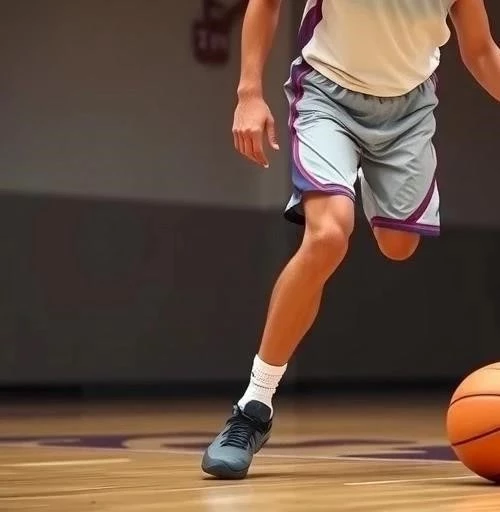
A basketball is not a drum to be slapped; it is a lively partner that answers a light, confident touch. Good dribbling lets you move, look up, and choose what happens next. Start slowly. Speed comes later.
Build your control
Stand with feet about shoulder-width apart, knees bent, hips low, and chest slightly forward. Keep your head up, as if you are reading the court’s next sentence. Hold the ball beside your body, not directly in front of your shoes. Relax your shoulders.
Spread your fingers comfortably over the ball. Push it down with your fingertips and the pads of your fingers, then let it rise naturally into your hand. Do not smack it with your palm or carry it. Your wrist supplies a soft snap; your fingers guide the direction. The ball should return near hip height, where you can control it without reaching.
Move without losing the conversation
Practise with either hand. Your stronger hand may feel like a trusted guide, but your weaker one is the key that opens the other side of the court. Keep the ball beside the foot opposite your defender, and use your body as a shield. Take small, balanced steps; the ball and your feet should travel together.
For a change of direction, lower your stance and push the ball across your body, below your knees, into the other hand. Make the move sharp, then accelerate. A crossover is a change of plan, not a flourish for its own sake. Keep it close enough that a defender cannot slip a hand between you and the ball.
A simple daily drill
- Dribble in place with your right hand for thirty seconds, then your left.
- Repeat while looking at a spot on the wall instead of watching the ball.
- Walk forward and back, keeping each bounce low and controlled.
- Add a gentle change of direction, then practise moving faster without losing balance.
If the ball escapes, do not chase speed. Check your posture, soften your hand, and shorten the bounce. Common troublemakers are standing upright, staring down, using the palm, and bouncing too far ahead. A quiet, controlled dribble is a small piece of freedom: it lets your eyes find teammates, gaps, and the hoop. Practise patiently, and soon the ball will seem less like equipment and more like an extra beat in your stride.
8 Comments. Оставить новый
“A lively partner” is a lovely way to introduce the ball. The article keeps its instructions clear while giving the practice a little personality.
I appreciate how it treats the weaker hand as an opportunity rather than a weakness. That small shift in perspective could make practice feel far less discouraging.
This article has a nice rhythm: settle your stance, find control, then add movement. It makes skill-building feel like assembling a tune one beat at a time.
This makes dribbling feel less like a trick and more like a conversation with the ball. The image of reading the court’s next sentence is especially memorable.
The detail about keeping the ball beside your body makes the guidance feel grounded in real play. It’s the kind of cue a beginner can remember mid-drill.
The advice to practise with your eyes on a spot on the wall is wonderfully simple. It turns a basic drill into a lesson in awareness.
A refreshingly practical guide: it explains not only what to do, but how each small adjustment helps. I like the reminder that a crossover should change the plan, not merely show off.
Clear, encouraging, and quietly clever. I especially like the idea that speed comes later; control gets the first word.