
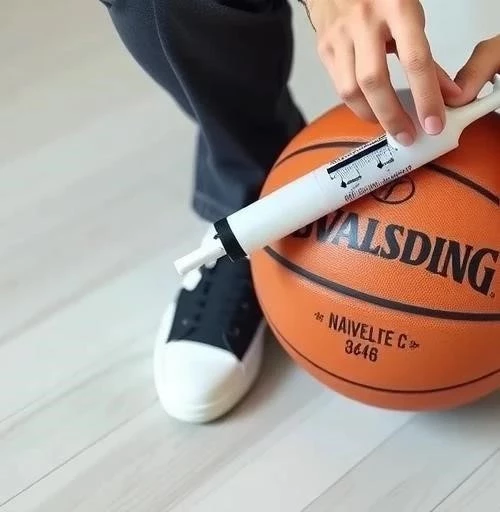
A flat basketball is frustrating, but forcing air into it with improvised tools can damage the valve or bladder. The safest solution is to find another suitable air source and use a proper ball needle or inflation adapter. If you have neither an air source nor an adapter, there is no dependable, safe way to inflate a basketball: borrowing a pump or visiting a sports shop is better than risking the ball.
Best emergency option: a compressed-air canister
A canister sold for cleaning keyboards may work as a temporary air source, but only if you can connect it securely to a basketball inflation needle. The thin plastic straw supplied with many cans is not a ball needle. Do not push it into the valve, wedge it in place, or hold it there under pressure: it can slip, damage the valve, or direct a concentrated blast where it should not go. Use a purpose-made adapter compatible with the canister and needle, and follow the product’s instructions.
- Check the ball’s recommended pressure. Look near the valve or consult the manufacturer’s instructions; the correct range varies by model.
- Make sure the ball, needle, and adapter are clean. Lightly moisten the needle with water or a small amount of silicone-based lubricant made for sports balls. Never insert a dry needle.
- Attach the needle to the adapter and connect it to the air source as instructed. Keep the can upright if its label says to do so.
- Insert the needle straight into the valve, gently and only as far as needed. Give the ball a very short burst, then stop and check its firmness or pressure.
- Repeat in brief bursts, allowing the can and ball to rest if they become cold. Stop at the manufacturer’s recommended pressure, remove the needle straight out, and check for leaks.
Do not use a long, continuous blast. Canned air can become extremely cold during use, and some products contain a propellant rather than ordinary air. Keep the can away from flames, heat, and your face, and follow all warnings on its label. If the can has no safe, secure connection for a ball needle, do not improvise one.
Other practical alternatives
Ask a nearby player, coach, school, gym, or sports shop to use a hand pump. A bicycle pump or floor pump can also work, but it needs a basketball needle; the pump’s nozzle alone will not seal properly against the ball’s valve. A service-station compressor is another possibility only with the right needle attachment and a pressure gauge. Use low-pressure, controlled bursts and watch the reading closely—high-volume compressors can overinflate a ball quickly.
Blowing through a drinking straw, using your mouth, or trying a household vacuum is not a reliable method. These approaches provide too little controlled pressure, may introduce moisture or dirt, and can hurt the valve. Do not use sharp objects, glue, or a needle that is not designed for sports balls. If the valve is damaged or air escapes as soon as you inflate the ball, stop and have it inspected or repaired.
How to check the result
A ball that feels firm is not necessarily inflated correctly. If you have a gauge, measure pressure according to the manufacturer’s specification. Without one, use the brand’s recommended bounce test as a rough check, not as a precise measurement. Avoid squeezing the ball excessively or continuing to add air just because it does not feel as hard as another ball; different models can have different recommended pressures.
Bottom line
For a one-time emergency, compressed air may help only when used with a secure, compatible needle adapter and in short bursts. The reliable fix is a proper pump—or help from someone who has one. Using the correct needle, lubricating it lightly, and respecting the ball’s pressure limit will protect the valve and help the basketball keep its shape.
5 Comments. Оставить новый
Clear, practical advice. I appreciate the reminder to check the manufacturer’s pressure range instead of guessing by feel.
A useful guide for a common problem. The short-burst approach and advice to let everything cool are good details.
This is sensible and easy to follow, especially the advice not to force a needle into the valve. I’d choose a proper pump whenever one is available.
The safety cautions make this more helpful than a simple list of inflation tips. The distinction between a cleaning-can straw and a proper adapter is important.
The warnings about improvised adapters are especially useful. It’s better to borrow a pump than risk damaging the ball’s valve.