
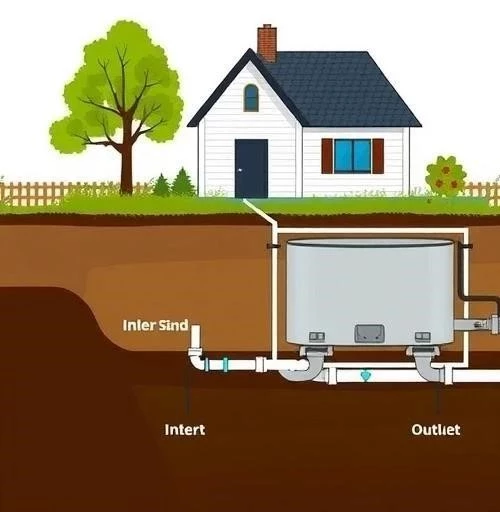
A septic tank for a private house provides autonomous sewage treatment where no central sewer is available. Correct installation protects the building, groundwater and soil. Before starting, check local sanitary standards and the manufacturer’s installation instructions. A bi septic installation may also require electrical work and specific commissioning procedures.
Choose the site and system
Consider the distance from the house to the septic tank, property boundaries, wells and watercourses. Site selection must follow local sanitary standards. Check the groundwater level and soil type: clay soil drains poorly and may rule out a conventional infiltration field. Choose a treatment facility and drainage system suited to the site, such as a filtration field or a filter well.
Plan the layout and excavation
Prepare a septic installation diagram showing the tank, inlet pipe, outlet pipe, ventilation and discharge area. Set the installation depth so the sewer pipe has a continuous slope recommended by the manufacturer, without sharp bends. Mark utilities before excavation. Earthworks and excavation must leave enough room to position the tank safely. Make a level sand cushion; use a concrete base where required by the design or soil conditions.
Install and connect the tank
Lower the tank into the pit according to the lifting instructions. Tank installation must keep the unit level. In areas with high groundwater, anchor the septic tank to the concrete base to prevent flotation. Connect the sewer pipe to the inlet and the outlet pipe to the drainage system. Seal every joint with compatible materials. Fit ventilation as specified. For an electric treatment unit, arrange a protected power connection in accordance with electrical codes.
Backfill and commission
Backfill gradually, following the manufacturer’s instructions; fill the tank with water if required to balance pressure. Do not use heavy machinery close to the unit. Check pipe slope, seals, ventilation and electrical connections. Commission the system by testing flow and confirming that alarms and pumps work. A properly installed autonomous wastewater treatment system should operate without leaks or backups.
Common mistakes and maintenance
Typical septic installation errors include ignoring groundwater, choosing an unsuitable site, incorrect depth, poor anchoring, inadequate slope and rushed backfilling. These can cause damage, odors or system failure. Regular septic maintenance includes inspection, sludge removal when needed, and care of the filtration area. The cost of septic installation depends on tank capacity, soil, excavation, electrical work and drainage design. Get a site assessment and written estimate before work begins.




3 Comments. Оставить новый
I appreciate the emphasis on checking local standards before choosing a site. Mentioning flotation risks and protected electrical connections also makes this guide more complete.
This is a clear, practical overview of the main steps involved. The reminders about groundwater, safe excavation and manufacturer instructions are especially useful.
The article is well organized and easy to follow. A checklist for final commissioning and maintenance would be a helpful addition.