
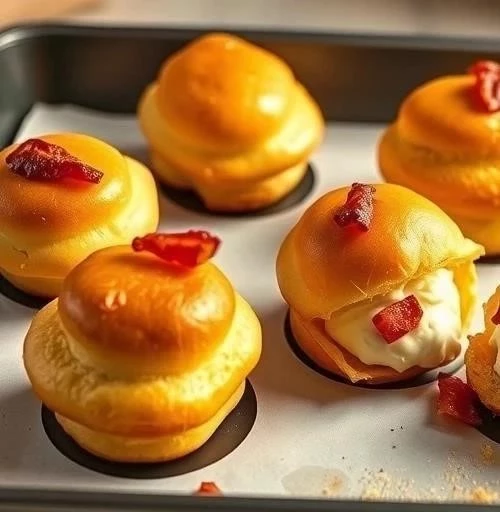
Profiteroles should rise into hollow, crisp shells, ready for a savory filling. When they turn flat, damp or dense, the cause is usually a chain of small errors—not a bad recipe. Reliable bacon profiteroles begin with accurate measurements and careful baking.
Make a stable choux pastry
Weigh the ingredients: changing the flour, butter, water or egg proportions changes the dough’s moisture. For choux pastry for profiteroles, bring the liquid and butter to a boil, add all the flour at once, then stir over heat until the paste forms a ball and a thin film appears on the pan. This flour-cooking step matters: undercooked paste holds too much moisture.
Cool the paste briefly. Add eggs gradually, mixing well after each addition. Stop when the dough is glossy and falls from a spatula in a thick V-shape. Too much egg makes it runny; too little prevents expansion. This is the right consistency for choux pastry, also used for éclairs.
Pipe and bake without losing steam
Pipe evenly spaced mounds of a consistent size, then smooth pointed tops with a damp finger. Small shells bake faster than large ones, so keep the size uniform. Preheat the oven fully. A useful starting point is 200°C for 10 minutes, then 175–180°C until deeply golden, usually another 15–25 minutes. Actual baking time depends on size and oven.
Use conventional heat unless you know your oven’s fan setting; convection can brown shells too quickly. Never open the oven during the first part of baking: escaping steam can make profiteroles collapse. If shells are pale or soft inside, they are underbaked. Dry them in the switched-off oven with the door slightly ajar for several minutes. This drying step helps create a crisp shell.
Fill with bacon
For a simple bacon filling, cook bacon until crisp, cool it, and fold it into cream cheese with herbs and black pepper. Let the mixture cool before filling. To fill profiteroles, make a small hole underneath and pipe in the savory cream. Fill close to serving time; store empty shells airtight and keep the filling refrigerated. Filled shells soften quickly.
Quick troubleshooting
- Why don’t profiteroles rise? The oven may be too cool, the dough too wet, or the eggs poorly incorporated.
- They collapse after baking: They may be underbaked, or the oven door was opened too soon.
- They stay raw inside: Bake longer at a lower temperature after the initial rise, then dry thoroughly.
These are common profiterole mistakes, but each has a practical fix: measure carefully, cook the flour paste, add eggs gradually, pipe evenly, and let the shells dry. Target search phrases include: заварное тесто для профитролей; профитроли с беконом; рецепт профитролей с беконом; почему профитроли не поднимаются; профитроли оседают после выпечки; профитроли не пропекаются; тесто для эклеров и профитролей; правильная консистенция заварного теста; температура выпечки профитролей; сколько выпекать профитроли; влажность теста; пропорции ингредиентов; заваривание муки; добавление яиц в тесто; отсадка профитролей; размер профитролей; режим духовки; конвекция при выпечке; нельзя открывать духовку; подсушивание профитролей; хрустящая корочка; начинка с беконом; крем-сыр с беконом; солёная начинка для профитролей; как наполнить профитроли; хранение профитролей; ошибки при приготовлении профитролей;


9 Comments. Оставить новый
The article gives a useful explanation of why choux pastry depends on consistency at each stage. The V-shape test is especially practical because it helps readers judge the dough rather than rely on a fixed number of eggs.
This is a helpful combination of technique and troubleshooting. The distinction between dough that is too wet and dough that lacks enough egg gives readers a way to understand problems instead of guessing.
The advice to keep piped shells uniform is a small but important point. Consistent sizing makes it easier to bake them evenly and reduces the chance of some shells collapsing while others are ready.
The baking advice is clear and appropriately acknowledges that ovens vary. Giving a temperature range and noting that shell size affects timing makes the guidance more realistic than promising one exact bake time.
The warning against opening the oven early is well explained: readers are told what can go wrong and why. The suggested drying step also gives a useful option for shells that look done but still feel soft.
Overall, the guidance is reasoned and approachable for someone new to choux pastry. The article connects each recommendation to a likely result, making the instructions easier to apply in the kitchen.
The savory bacon filling makes the recipe idea distinctive, while the instructions keep the focus on the pastry techniques that matter most. Letting the filling cool before piping is a sensible practical detail.
I appreciate the emphasis on weighing ingredients and cooking the flour paste thoroughly. Those details explain how to prevent excess moisture, which is more helpful than simply advising readers to follow the recipe carefully.
I like that the article recommends conventional oven heat unless the reader knows how their fan setting behaves. That qualification avoids presenting one setting as universally reliable.