
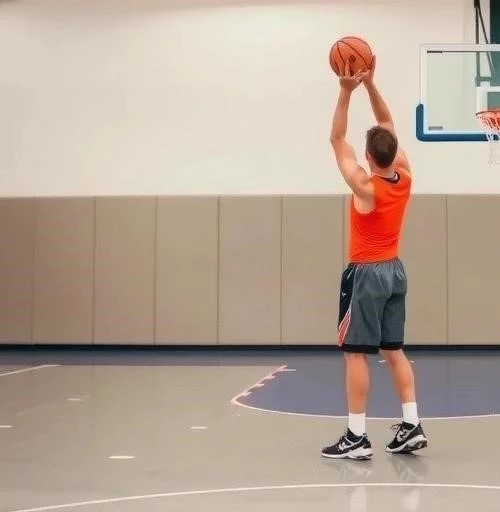
A good shot is not a shove. It is a small, repeatable chain of movements that sends the ball on a graceful arc toward the hoop. Think of your hands as the launch crew, your legs as the engine, and your follow-through as the final instruction: keep going that way.
Build a steady launchpad
Stand with your feet about shoulder-width apart, knees soft, and body balanced. If you shoot right-handed, place your right foot slightly ahead; reverse that for your left. Face the basket comfortably—not necessarily square-on—and let your hips and shoulders line up with your shooting side. Balance matters more than copying somebody else’s exact stance.
Give each hand a job
Rest the ball on your shooting hand, with your fingers spread and the palm leaving a little breathing room beneath it. Your fingers, not your palm, should control the ball. Place the guide hand lightly on the side. It steadies the ball, but it should not push it. Imagine your shooting hand is the pen and your guide hand is only holding the paper still.
Find your shooting pocket
Bring the ball to a comfortable spot near your chest or just above it. Keep your elbow beneath the ball, pointing generally toward the basket. Avoid forcing your arm into a rigid, perfectly straight line: a relaxed, repeatable position is more useful than a pose that feels unnatural; Let your eyes settle on a small target, such as the back of the rim.
Let the power travel upward
Bend your knees slightly, then extend your legs as your shooting arm rises. The movement should flow from the floor through your body and into your fingertips. Release near the top of your reach, without jumping so hard that you lose balance. For a close shot, use less force; from farther away, add power with your legs instead of flinging the ball with your shoulder.
Release, then freeze
As your elbow extends, let the ball roll off your index and middle fingers. Finish with your wrist relaxed and fingers pointing toward the hoop, as if reaching into a cookie jar on a high shelf. Hold that follow-through until the ball reaches the rim. A clean release usually gives the ball gentle backspin. If your guide hand is flicking sideways, it may be steering the shot off course.
Practice with a purpose
- Start close to the basket. Shoot slowly, concentrating on hand placement and a soft release.
- Take a few shots from several short distances. Move back only when your form stays comfortable and balanced.
- Track makes and misses. Notice whether the ball falls short, sails long, or drifts sideways; change one thing at a time.
- Finish with a small set of game-like shots, stepping into position and resetting between attempts.
Common flight problems
Short? Use your legs and finish fully. Long? Reduce the force; don’t stiffen your arms. Sideways? Check your guide hand and keep your body balanced. Flat? Add a comfortable arc by releasing upward, not straight at the rim. One miss is information, not a verdict.
There is no magic angle or identical form for every player. Arm length, strength, and comfort differ, so build a motion you can repeat without pain. Begin close, practice patiently, and ask a coach to check your technique if you’re unsure. The goal is not to make every shot look dramatic. It is to make the next one more deliberate—and to give the ball a beautiful, hopeful arc.
5 Comments. Оставить новый
This makes shooting feel less like a trick and more like a quiet conversation between the floor and the fingertips. The “launch crew” image is especially memorable.
Clear, warm, and easy to picture. I especially appreciate the reminder that the guide hand is a stabilizer, not a co-pilot grabbing the controls.
I like how the advice treats balance as personal rather than prescribing one perfect pose. It turns practice into a search for a reliable rhythm, not a contest in looking polished.
The description of power traveling upward gives the whole motion a satisfying sense of direction. It’s the sort of explanation that might make a missed shot feel like a clue instead of a verdict.
A refreshingly practical guide: it gives beginners useful landmarks without insisting that every body move like a textbook diagram. The pen-and-paper comparison is a clever touch.