
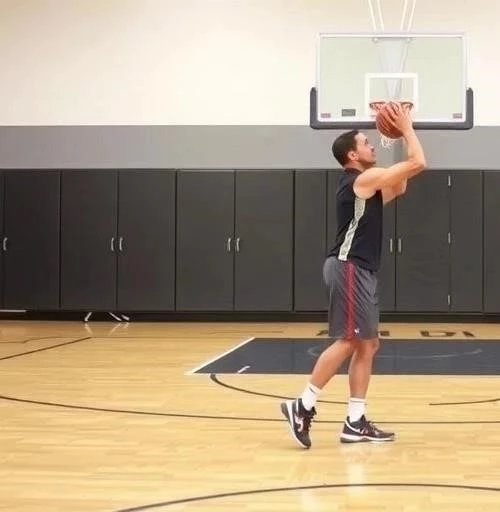
A reliable basketball shot is built from balance, hand placement, coordinated movement, and regular practice. The aim is not to force the ball toward the hoop, but to use a repeatable motion that sends it on a controlled arc. These fundamentals apply to beginners and can also help experienced players refine their technique.
Set a balanced stance
Stand facing the basket with your feet about shoulder-width apart. Place the foot on the shooting-hand side slightly ahead, and let your knees bend comfortably. Keep your weight evenly distributed over your feet, your torso upright, and your shoulders relaxed. A stable stance makes it easier to direct the ball and maintain balance through the release. Avoid leaning backward or twisting unnecessarily.
Hold the ball correctly
Rest the ball on the pads of your shooting hand, not flat in the palm. Spread your fingers comfortably and point them upward, with the index and middle fingers near the center of the ball. Leave a small space between your palm and the ball. Place your other hand lightly on its side to steady it. The guide hand supports the ball; it should not push or twist it during the shot.
Align your body
Bring the ball into a comfortable shooting pocket, usually around chest or lower-face height. Keep your shooting elbow beneath the ball and generally aligned toward the basket. Your wrist should be relaxed, and your forearm should form a natural line toward the target. Exact alignment varies between players, so seek a position that feels comfortable and allows the ball to travel straight without strain.
Coordinate the shooting motion
Begin with a slight bend in your knees. As you rise, move the ball smoothly upward, extending your legs and shooting arm in one coordinated action. Release near the top of your motion, rather than throwing the ball abruptly from your chest. Extend your elbow and snap your wrist so the ball rolls off your fingertips. The guide hand should come away without adding force.
Finish with a relaxed follow-through
After release, keep your shooting arm extended toward the hoop, with the wrist bent and fingers pointing down. Hold this position briefly. A consistent follow-through helps you repeat the same motion and gives the ball a useful backspin. Keep your body balanced and land close to where you jumped, if you jumped at all. Do not pull your arm away immediately to watch the result.
Aim and adjust
Choose a clear visual target, such as the center of the rim or a spot on the backboard when using a bank shot. Send the ball in a high, controlled arc rather than on a flat line. If shots repeatedly miss short, consider using more leg drive; if they travel too far, reduce force while keeping the motion smooth. Change one element at a time so you can identify what helps.
Practice with purpose
- Start close to the basket and take slow shots, concentrating on hand position and a straight release.
- Move back gradually only when you can repeat the motion with control.
- Use short sets, alternate locations, and record makes and misses to notice patterns.
- Practice free throws and shots after a light dribble, then add speed or a defender as your control improves.
Quality matters more than rushing through a large number of attempts. Stop if you feel pain, and allow time for rest. For young players, use a ball and hoop suited to their size and ability. With patient practice, a balanced stance, clean release, and steady follow-through can become dependable habits.

9 Comments. Оставить новый
The advice on balance and avoiding unnecessary leaning gives readers practical points to check while practicing.
The article presents the main shooting fundamentals in a clear sequence, from stance to release.
The sections are organized around individual parts of the shooting technique, which makes the information easy to follow.
The release instructions cover elbow extension, wrist action, and the role of the guide hand in a concise way.
The article explains how the legs and shooting arm work together during the shot without making the motion sound overly complicated.
This is a practical overview of basic shooting mechanics, with each section focused on a different part of the motion.
The distinction between the shooting hand and the guide hand is useful for understanding how to control the ball.
The guidance on hand placement is specific, including the reminder to leave a small space between the palm and the ball.
The note that alignment can vary between players adds useful flexibility to the technical guidance.