
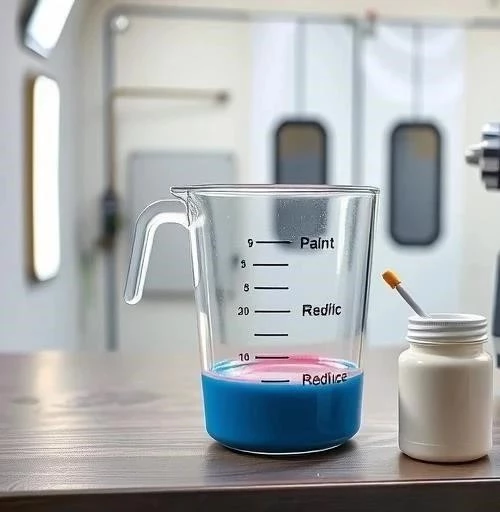
Automotive acrylic paint should be thinned only with a product approved for that specific paint system. The right choice is usually the manufacturer’s acrylic thinner or reducer—not water, household solvents, or a product selected simply because its label says “paint thinner.” The correct reducer helps the paint atomize, flow, and dry as intended. An incompatible one can cause poor adhesion, uneven gloss, slow drying, or surface defects.
First identify the paint system
“Acrylic automotive paint” can refer to different products. A single-stage acrylic color, a two-component (2K) acrylic urethane, an acrylic primer, and a waterborne basecoat may all require different mixing products. Read the product label and technical data sheet (TDS) before opening the can. Check whether the paint needs reducer, hardener, or both, and note the specified ratio, spray conditions, and pot life.
Do not assume that all acrylic products can be mixed together. A reducer for clearcoat may not suit a color coat, and a waterborne basecoat thinner is not interchangeable with a solvent-based acrylic reducer. If the label or TDS is missing, ask the paint supplier for the exact product information rather than guessing.
Reducer, solvent, water, and hardener: what is the difference?
- Reducer or thinner: A system-matched product used to adjust viscosity and evaporation rate. Automotive suppliers may use “reducer” and “thinner” differently, so follow the TDS rather than relying on the name.
- Water: Suitable only when the paint manufacturer specifies water or a dedicated waterborne thinner. It is not a general substitute for solvent-based automotive reducer.
- Hardener or activator: A curing component required by some 2K products. It is not a thinner and should not be substituted for one.
- Retarder: A special additive that slows drying in approved situations. Use it only when the paint maker allows it and at the stated amount.
How much reducer should you add?
There is no universal mixing ratio for automotive acrylic paint. Follow the ratio printed in the TDS, which may be expressed as parts by volume, such as paint-to-reducer, or as a percentage. For example, a hypothetical instruction of 4:1 means four measured parts of paint to one part of the named reducer; it does not mean four parts paint to one part hardener unless the sheet says so. Some products require no additional reducer, while others call for a specified percentage. Treat online ratios as examples only, not as instructions for your product.
Measure accurately with mixing cups or a scale if the manufacturer gives weight ratios. Stir the paint thoroughly first, then add the correct components in the prescribed order. Do not estimate by eye or add extra reducer just to make spraying feel easier. Too much can reduce film build, cause runs or poor coverage, and affect curing; too little can produce rough texture, dry spray, or poor leveling.
Mixing for a spray gun
- Confirm the paint, reducer, hardener, and mixing ratio from the TDS. Check the recommended temperature range and gun setup.
- Stir the paint until its color and consistency are uniform. Measure each component in a clean, compatible mixing container.
- Add reducer and, where required, hardener in the order specified by the manufacturer. Mix gently but thoroughly; avoid whipping air into the material.
- Strain the mixture through the recommended paint filter into the gun cup. Use a viscosity cup only if the product instructions specify a target and test method.
- Spray a test panel before painting the vehicle. Check atomization, coverage, flash time, and finish, then adjust only within the TDS limits.
Gun nozzle size, air pressure, application technique, and shop temperature also affect the result. They do not replace the specified mixing ratio. If the paint appears too thick, verify that it has been stirred, measured, and stored correctly before adding more reducer.
Temperature, drying, and finish
Many product lines offer reducers with different evaporation speeds for different temperatures or panel sizes. Select one only as directed by the paint maker. A reducer that evaporates too quickly may leave a dry, rough finish; one that is too slow can contribute to runs, trapped solvent, or delayed drying. Observe the stated flash time between coats and curing instructions. Do not judge readiness by touch alone.
Important safety precautions
Automotive coatings and reducers can release harmful vapors and are often highly flammable. Work in a properly equipped spray area, keep ignition sources away, and follow the product safety data sheet (SDS). Wear the protective equipment specified by the SDS. Spraying 2K products may expose you to isocyanates, which can cause serious harm; a simple dust mask is not adequate protection. Use only suitable professional respiratory protection and ventilation, and do not spray if you cannot meet the required controls.
Common mistakes to avoid
- Using water in solvent-based paint, or ordinary mineral spirits, lacquer thinner, or a random universal solvent.
- Mixing brands or product lines without written compatibility guidance.
- Confusing a thinner ratio with a paint-to-hardener ratio.
- Adding reducer to a ready-to-spray product unless the TDS permits it.
- Skipping a test spray, straining, ventilation, or required protective equipment.
Bottom line: Thin automotive acrylic paint with the exact reducer or thinner specified for that product, in the precise ratio stated on its TDS. Because formulas vary, there is no safe all-purpose proportion. If you cannot identify the paint system, pause and confirm it with the manufacturer or supplier before spraying.

4 Comments. Оставить новый
A practical reminder to check the technical data sheet before mixing. Automotive coatings vary so much that guessing at the reducer or ratio is risky.
Useful overview for anyone working with different acrylic products. The examples show why a reducer suitable for one coating may not work for another.
This is a clear explanation of why water is not a universal substitute for automotive paint thinner. The advice to contact the supplier when documentation is missing is sensible.
The distinction between reducer, hardener, and retarder is especially helpful. It makes clear why choosing a product by its label alone can lead to problems.