
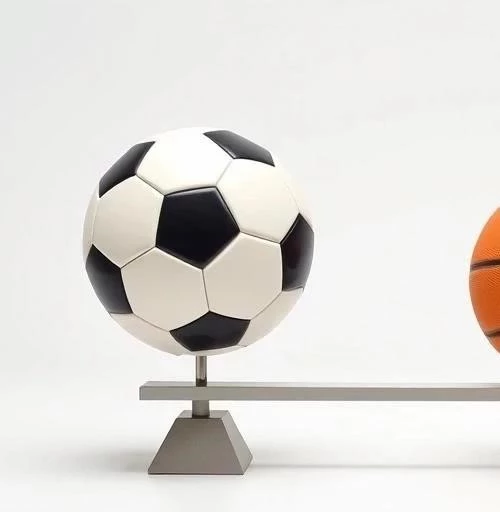
In most standard adult versions, a soccer ball is lighter than a basketball. The comparison is not just a matter of appearance: official size and weight ranges show a clear difference. A regulation size 5 soccer ball weighs about 410–450 grams (14.5–15.9 ounces). A standard adult basketball commonly weighs around 567–650 grams (20–23 ounces), depending on the rules and the ball’s construction.
Why the numbers matter
Even the lightest typical basketball is heavier than the heaviest regulation size 5 soccer ball. At the middle of those ranges, the soccer ball weighs roughly 430 grams, while a basketball is about 600 grams. That makes the basketball heavier by around 170 grams—close to 40 percent of the soccer ball’s mass. So, if the question is which one is easier to lift or carry, the soccer ball is usually the straightforward answer.
Mass, weight, and feel
In everyday speech, people say a ball “weighs” a certain amount. Strictly speaking, mass is measured in grams or kilograms, while weight is the force gravity exerts on an object. On Earth, a greater-mass ball also has greater weight. The distinction does not change the practical comparison: the usual adult basketball has more mass and therefore feels heavier in the hand.
How heavy a ball feels during play is not determined by mass alone. A basketball is larger and has a textured surface designed for gripping and bouncing. A soccer ball is built for kicking and heading, and its panels and materials affect its feel. Air pressure, moisture, wear, and the particular model can also influence handling. These factors may change a player’s impression, but they do not normally reverse the standard weight comparison.
Important exceptions
“Basketball” and “soccer ball” each describe several sizes. A small youth or mini basketball can weigh less than a full-size soccer ball. Likewise, children’s soccer balls are lighter than adult size 5 balls. Special training balls may be deliberately heavier or lighter, and a waterlogged or damaged ball may fall outside its usual range. Therefore, the conclusion applies to typical adult match balls, not every ball sold for either sport.
For a fair comparison, check the printed size and the manufacturer’s stated mass rather than relying on diameter or appearance. A ball that looks bigger is not automatically heavier, and air pressure affects bounce more than the basic mass listed for the model.
A standard adult soccer ball is generally lighter than a standard adult basketball. Their usual weight ranges do not overlap: soccer balls are around 410–450 grams, while adult basketballs are roughly 567–650 grams. Smaller versions can be exceptions, but for ordinary full-size sports equipment, the soccer ball is the lighter choice.

8 Comments. Оставить новый
This explanation is well organized: it gives the short answer first, then supports it with measurements and relevant exceptions. That structure makes the article useful for both quick readers and those who want more detail.
I appreciate the distinction between mass and weight. It adds useful scientific context without changing the practical answer for someone simply trying to decide which ball is heavier.
The article sensibly notes that construction, pressure, and moisture can affect handling. Those details help explain why a ball may feel heavier or lighter than expected without undermining the usual comparison.
The article gives a balanced answer rather than treating the comparison as universal. Its caveats about different sizes and special training balls make the conclusion more reliable.
The explanation connects the measurements to a practical question—what is easier to carry—while making clear that handling during play depends on more than mass alone. That is a useful distinction.
The discussion of ball size is an important qualification. Without it, readers might assume every basketball is heavier than every soccer ball, even though youth and mini versions can differ.
Including approximate ranges is more informative than offering a single number, since actual weights vary by model and rules. The comparison remains straightforward while acknowledging that variation.
The comparison is clear because it uses official weight ranges rather than relying on how the balls feel in hand. The estimate of roughly 170 grams between typical examples also makes the difference easy to understand.