
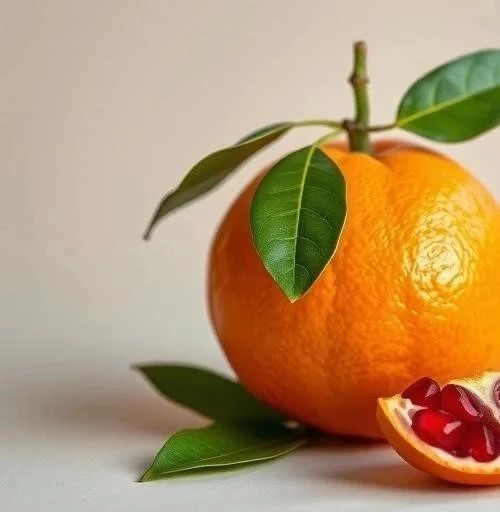
There is no officially recognized fruit called an “orange-pomegranate hybrid.” An orange cannot normally be crossed with a pomegranate to create a new fruit, so there is no accepted botanical name for such a cross. If you encounter a name for it online or in a shop, it is likely a nickname, a product label, or a reference to a recipe—not the name of an established hybrid.
Why the two fruits do not cross
Sweet oranges belong to the citrus group and are classified as Citrus × sinensis. Pomegranates are Punica granatum, a plant from a separate botanical family. To make a conventional fruit hybrid, pollen from one compatible plant fertilizes the ovule of another, and the resulting seed carries genetic material from both parents. Orange and pomegranate are too distantly related for this ordinary breeding process to produce a viable hybrid.
It is also easy to mistake a change in a fruit for a cross. If a flowering orange tree receives pomegranate pollen, that does not turn the orange into a pomegranate-orange. The fruit’s flesh develops from the orange tree’s tissues; pollination chiefly affects the seeds and their genetics. Likewise, grafting branches of the two plants onto one tree would not combine their DNA. Each branch would still produce its own kind of fruit.
What the phrase may refer to
When someone says “orange crossed with pomegranate,” they may mean one of several things:
- A juice blend: orange and pomegranate juices mixed together.
- A recipe: the two fruits served in a salad, dessert, or drink.
- A fanciful name: a catchy description used for a product, not a botanical classification.
- A misunderstanding: confusion with genuine citrus hybrids or with fruit that has an unusual appearance or flavor.
These uses can be perfectly reasonable in everyday language, but they do not establish a new fruit species or cultivar. Unless a seller provides reliable evidence of a named, reproducible cultivar, the safest description is simply “orange and pomegranate blend” or “orange-pomegranate drink.”
Could science make one in the future?
Modern biotechnology can move or edit genes in ways that traditional breeding cannot, so researchers can explore traits across a wider range of organisms. However, that possibility does not mean an orange-pomegranate fruit currently exists. Creating a plant that reliably grows edible fruit would involve substantial biological challenges, testing, and safety evaluation. A product made by mixing the fruits—or a claim on social media—is not proof of such a creation.
The accurate answer is that an orange crossed with a pomegranate has no established name, because it is not a recognized natural hybrid. Call a mixture by its ingredients, and treat any claimed hybrid name as informal unless credible botanical evidence supports it.


9 Comments. Оставить новый
The examples of juice blends, recipes, and fanciful product names help clarify how the phrase might be used without implying a real botanical hybrid.
The writing is organized well, moving from the scientific answer to everyday meanings of the phrase. This structure makes the information accessible to both curious readers and gardeners.
I appreciate the explanation that pollination does not change the fruit into a cross between the two plants. That addresses a common misconception in a straightforward way.
The article sensibly advises readers to look for reliable evidence before accepting a seller’s claim about a named cultivar. That is a practical way to assess unusual fruit labels.
This is a concise, informative explanation. The point that the fruit develops from the orange tree’s tissues makes the pollination discussion particularly helpful.
The discussion of grafting is a valuable addition. It distinguishes growing two types of fruit on one tree from combining the plants genetically.
A clear and measured explanation that avoids confusing a flavorful combination with a genuine hybrid. The distinction between informal naming and botanical classification is the article’s strongest point.
The comparison of their botanical families makes the conclusion easy to follow. It gives readers a reason for the answer rather than simply asserting that the hybrid does not exist.
The article clearly explains why an orange and a pomegranate cannot produce a conventional hybrid. The distinction between botanical classification and casual product names is especially useful.