
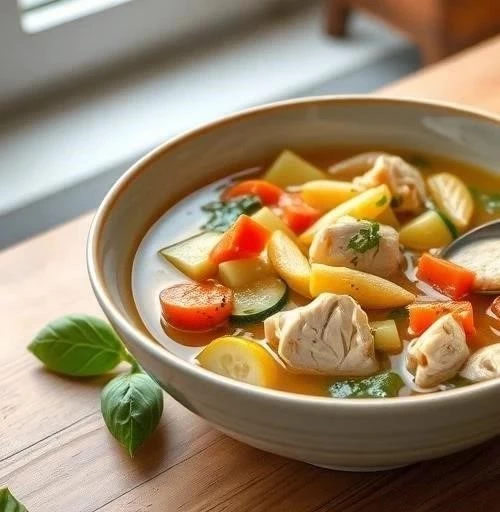
Explain why Italian-style chicken-and-zucchini soup works for every day: chicken breast and chicken broth make a satisfying base, while zucchini, bell pepper, carrot, onion, garlic, and potatoes add flavor and substance.
Chicken and broth fit; zucchini, peppers, carrots, onion, garlic, and potatoes make it hearty.
Present the ingredients and their roles: tomatoes or canned tomatoes bring acidity; olive oil and Italian herbs—basil, oregano, and thyme—create an Italian profile; Parmesan and fresh herbs finish the soup.
Tomatoes, or tomatoes in their own juice, add bright acidity that balances the mild zucchini and chicken without overpowering them. Olive oil carries aroma and gives the vegetables a rounded, savory note, while Italian herbs bring a clear regional character: basil is sweet, oregano earthy, and thyme gently aromatic. Parmesan contributes salty depth, and fresh herbs add a clean finish; each ingredient adds a distinct note, so the blend tastes balanced without excess seasoning and feels complete.
Give a step-by-step recipe for stovetop cooking: sauté the onion, carrot, bell pepper, and garlic in olive oil; add chicken breast, potatoes, broth, and tomatoes; then simmer and add zucchini near the end so it keeps its texture.
- Warm olive oil in a pot; cook chopped onion, carrot and bell pepper until very soft. Stir in minced garlic for 30 seconds since it releases aroma quickly.
- Add diced chicken breast, potatoes, chicken broth, and tomatoes. Bring to a gentle boil, then lower heat and simmer until the chicken is cooked and potatoes are tender.
- Stir in zucchini near the end and cook briefly; this timing helps it stay pleasantly firm rather than turn mushy. Check tenderness before serving.
Explain why this simple recipe suits a quick lunch: it combines lean chicken with vegetables, making a light soup that is still filling and practical as a homemade soup.
This soup suits a quick lunch most days because lean chicken makes it satisfying, while vegetables keep it fresh and the broth light too. That balance helps curb hunger without making midday eating feel heavy. As homemade soup, it is practical on busy weekdays: a warm bowl offers comfort, fits an everyday routine, and feels substantial enough to carry you through the afternoon. Its simple, familiar character also makes it easy to enjoy regularly, rather than save for a special occasion.
Close with serving tips and a note on dish calories: garnish with Parmesan and fresh herbs, adjust the Italian herbs to taste, and explain that calories vary with portion size and ingredient choices.
Top each bowl with Parmesan and fresh herbs for savory depth and a brighter aroma. Adjust the Italian herbs gradually, because their intensity can vary and a small change keeps the flavor balanced. Dish calories depend on serving size and ingredient choices: more cheese or oil raises the total, while broth and vegetable proportions also affect each bowl. For a fair calorie estimate, calculate the ingredients used and divide by the number of portions; treat the result as a guide, not a fixed value, since ladles and toppings differ.



9 Comments. Оставить новый
I appreciate that the ingredient roles are explained rather than simply listed. The notes on tomato acidity, herbs, and Parmesan make it easier to understand how the flavors work together and how to adjust the soup to taste.
I like the flexibility of using fresh tomatoes or canned ones. That makes the soup more accessible year-round, while the suggested herbs still give it a recognizable Italian-inspired flavor.
This sounds practical for a weeknight meal, and the stovetop directions are straightforward. One helpful point is to check that both the chicken and potatoes are fully cooked before serving, since their cooking times can vary depending on how they are cut.
The guidance to sauté the vegetables before adding the liquid is a useful foundation for building flavor. Keeping the garlic’s cooking time brief is also sensible, since it can become bitter if left in the pot too long.
A helpful, approachable overview of a homemade soup. The timing advice for the zucchini stands out, and the explanation of how acidity and herbs balance the mild chicken and vegetables gives readers a useful starting point for seasoning.
The recipe seems well suited to lunch because it can be made in one pot and offers a satisfying mix of ingredients. Parmesan and fresh herbs sound like effective finishing touches, adding flavor without complicating the cooking.
The recipe explains the soup’s balance well: chicken and potatoes make it filling, while zucchini and the other vegetables keep it from feeling too heavy. Adding the zucchini near the end is a useful detail because it helps preserve its texture.
This would be easy to adapt with vegetables already on hand. The article makes clear that the core idea is a savory broth with chicken and vegetables, while the herbs and finishing touches can be adjusted.
The recipe’s approach to keeping the soup light but substantial is convincing. Lean chicken provides protein, and the vegetables add variety without relying on cream or other heavy ingredients.