
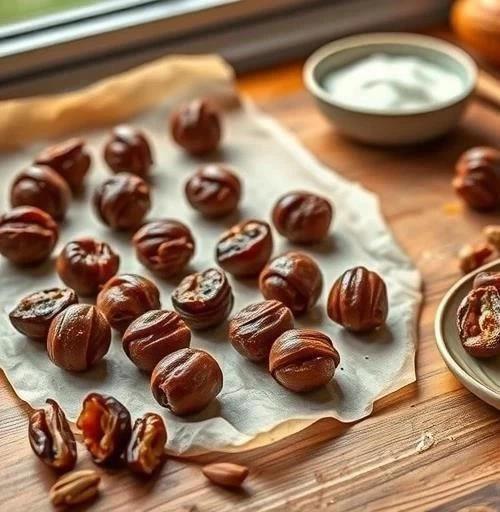
Explain why homemade date candies make a convincing sugar-free dessert
Date sweetness makes sugar-free desserts appealing and practical.
Argue that dates provide natural sweetness and a sticky texture, making these natural sweets and dried-fruit treats a practical alternative to sweets without refined sugar. Present them as a healthy snack, a dessert with tea, and homemade energy balls.
Dates supply concentrated natural sweetness and a soft, sticky texture, so these dried-fruit treats can satisfy a sweet craving without refined sugar. That makes them a persuasive choice for a healthy snack, a fine dessert with tea, or homemade energy balls during busy days: their fruit-based sweetness offers flavor and quick enjoyment without relying on added sugar.
Introduce the basic recipe and flexible ingredients
Dates make flexible, satisfying treats because nuts allow variations.
List dates and nuts—such as walnuts, almonds, or cashews—along with optional rolled oats, peanut butter, or other dried fruit. Explain that these ingredients make the recipe adaptable while keeping the candies satisfying.
Use dates as the base, then choose walnuts, almonds, or cashews to add richness and substance. Rolled oats can make each bite heartier, while peanut butter brings a creamy note; other dried fruit offers a different balance of flavor. This flexible mix is convincing because you can adapt it to what is available and still make satisfying candies. Small swaps can work well.
Show how to make the candies without special equipment
Simple tools suffice, making homemade sweets practical at home too;
Describe how to blend the ingredients in a blender, shape the mixture into balls, and roll them in cocoa, shredded coconut, or sesame. Emphasize that this no-bake dessert needs no special molds, so date candies are easy to make at home.
Blend the ingredients until the mixture holds together; this simple step gives the candies an even texture. Pinch off portions and shape them into balls by hand, then roll each in cocoa, shredded coconut, or sesame for a neat finish. Because no baking or special molds are needed, this method is practical: usual kitchen tools are enough to make date candies at home.
Cover variations, serving, and storage
Chill treats to preserve shape; varied coatings suit teas or snacks.
Suggest cocoa-coated candies, coconut-covered bites, or versions with extra nuts, then explain that refrigerator storage helps them keep their shape and texture. These simple steps make the candies convenient to serve as a tea-time dessert or portable snack.
Choose cocoa for a deeper note, coconut for a lighter finish, or extra nuts for crunch; these variations make each batch easy to tailor. Keep the candies in a sealed container in the refrigerator, where cool storage helps preserve their shape and texture. Chilled portions are convenient to serve with tea or carry as a portable snack. This keeps bites neat for serving.
Conclude with who can enjoy them and why
Vegans and fasting eaters can enjoy these; they avoid refined sugar.
Position the recipe as a fasting-friendly dessert and a source of vegan sweets and fitness-style “PP” candies. Conclude that homemade date candies offer a customizable, no-bake option for anyone seeking a useful snack without refined sugar.
These date candies suit fasting days and vegan diets, while their fitness-style “PP” appeal offers another reason to choose them. Because the recipe is customizable and requires no baking, it is a practical snack for people seeking sweetness without refined sugar. That flexibility makes them an easy homemade option for varied routines. A helpful option for many days.

9 Comments. Оставить новый
The straightforward preparation makes these candies seem manageable even for someone without much cooking experience. Blending, shaping, and coating are clear steps, and the lack of special equipment is a practical advantage.
The article makes a convincing case for date candies as a simple no-bake treat. Its strongest point is explaining how dates provide both sweetness and stickiness, which helps the recipe hold together without refined sugar.
The ingredient suggestions help readers imagine how flavor and texture can change with each variation. Rolled oats, peanut butter, and different nuts each offer a distinct reason to customize the basic mixture.
The article presents the candies as useful for more than one occasion, from a snack to something served with tea. That range gives the recipe a practical appeal beyond being just another dessert idea.
This is an inviting introduction to homemade date candies, especially for readers looking for a simple alternative to conventional sweets. The flexible ingredients and uncomplicated method make the idea feel both accessible and easy to personalize.
One useful clarification would be that “sugar-free” here means no refined or added sugar, rather than no naturally occurring sugar. Dates are naturally sweet, so making that distinction would keep the health description precise.
I appreciate the emphasis on adaptable ingredients. Offering several nut options and optional additions makes the recipe approachable for different tastes and what readers already have in their kitchens.
The suggested coatings add a nice finishing touch without complicating the recipe. Cocoa, coconut, and sesame also give readers easy ways to vary the appearance and add contrasting flavors.
The article is easy to follow and gives a persuasive explanation of why dates work so well as a base. A brief note about adjusting the mixture if it is too dry or sticky would make the practical guidance even stronger.