
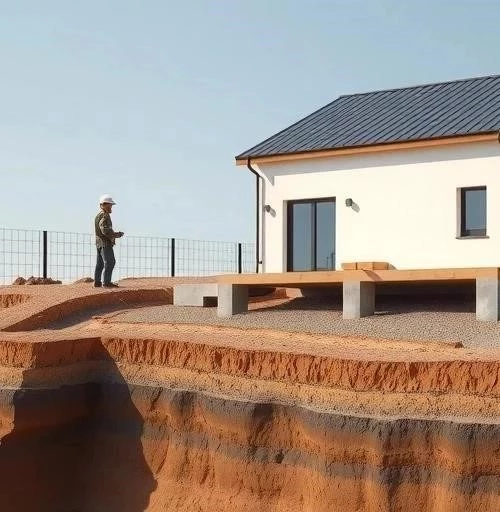
Metal tile can be a practical roofing covering for a home on a difficult site, but it does not solve problems below ground. Its main advantage is its low roofing material weight: a lightweight roof reduces foundation load compared with many heavier coverings. This can support building stability, especially on weak soils. However, a light roof cannot compensate for poor foundations, inadequate drainage or incorrect design.
Start with the ground, not the roof
Construction on challenging soils requires geological surveys before the foundation and roof are selected. The soil type, bearing capacity and groundwater level determine whether the site has weak, frost-susceptible or collapsible soils. These conditions can cause uneven settlement, frost heave and foundation deformation. A designer should calculate loads from the entire building, including snow, wind, roof framing and finishes—not just compare roofing products by weight.
A pile foundation, including screw piles where suitable, may transfer loads to stronger layers. A slab foundation can spread loads across a larger area, while a strip foundation may work where soil conditions are sufficiently uniform. None is universally best: the choice must follow survey results and structural calculations. Site drainage and foundation waterproofing also matter, since water can weaken soil or increase frost-related movement.
Roof design and installation
Metal tile is a sound choice when the supporting structure is designed for it. The roof truss system and battens must be sized for local snow and wind loads, and the roof slope must comply with the product specification. Correct installation of metal tile includes secure fixings, ventilation and careful detailing at valleys, edges and penetrations. A complete roof assembly should include appropriate underlay, ventilation and roof insulation; otherwise condensation can damage timber and shorten the roof service life.
Corrosion protection is essential. Avoid damaging the coating during cutting and handling, and use compatible fasteners. Quality products and skilled installation can provide durable protection, but maintenance remains necessary.
Make the decision by calculation
Roofing material selection should balance weight, durability, climate and total cost. Metal tile often helps limit dead load, yet the final load calculation must include snow, wind and the structure itself. On complex soils, a geotechnical engineer and structural designer should coordinate foundation and roof choices. The result is not simply a light roof, but a stable, well-drained building with a roof suited to the site.
3 Comments. Оставить новый
The roof-installation section adds important context: low material weight alone does not ensure a durable roof. Snow and wind calculations, ventilation and careful detailing all affect performance, so professional design and installation remain essential.
The article makes a useful distinction between reducing roof weight and solving foundation problems. That prevents readers from treating lightweight roofing as a substitute for soil investigation and proper structural design.
I appreciate the emphasis on choosing a foundation from survey results rather than assuming one type suits every difficult site. The discussion of drainage and groundwater also helps show why soil conditions must be considered as part of the whole building design.