
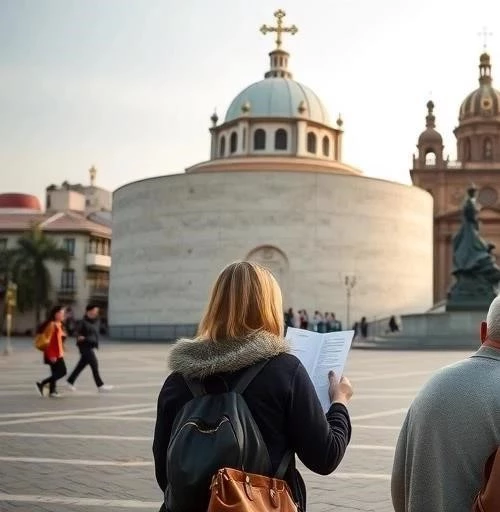
The Basilica of Our Lady of Guadalupe is one of Mexico City’s major cultural and religious landmarks. Its location in the northern part of the city makes it a natural addition to a Mexico itinerary, but it is best treated as a dedicated visit rather than squeezed between several distant attractions. A measured plan leaves room for the site itself, travel time and rest.
Allow time for the visit
The pilgrimage complex includes more than the modern basilica: visitors can also see older religious buildings and open spaces. Allow several hours, adjusting for services, accessibility needs and interest in the architecture. On important religious dates, visitor numbers rise sharply, and queues can make a short stop unrealistic. Check current opening information before setting out.
To get to the basilica, use Mexico City’s public transport or a taxi from your starting point. The Metro can be useful, though the final approach and walking time should be included in the schedule. Compare routes on the day and leave a buffer for transfers and traffic. Practical transport planning matters as much as the list of sights.
Fit the visit into a wider route
For a one-day outing, pair the basilica with one nearby cultural attraction, such as the Plaza of the Three Cultures, rather than crossing the city repeatedly. The historic center of Mexico City deserves its own time. Combining both areas in one day is possible, but can create a packed schedule; decide according to energy, transport conditions and priorities.
Travelers planning a route through central Mexico can place the basilica at the beginning or end of their Mexico City stay. On an independent trip, keep the number of major stops realistic. The duration of the journey, route density and rest days all affect the optimal pace. A slower trip is not a missed opportunity: it gives each place more context.
Choose a less obvious season
Shoulder season and the low tourist season may bring fewer crowds, although visitor flows vary by date and religious calendar. Less waiting is possible, not guaranteed. Weather in Mexico City is generally mild, but seasonal rain can affect walking and transit. During the rainy season, carry a light waterproof layer and allow extra time for delays.
A spring trip to Mexico may offer comfortable conditions, while an autumn trip can coincide with rainy periods; local forecasts are more useful than broad seasonal assumptions. Off-peak travel can make the complex calmer, but check access and event schedules in advance. Religious tourism remains important throughout the year, so respectful behavior is appropriate regardless of crowd size.
Keep the itinerary balanced
Build the day around the basilica, then add only a nearby stop or a relaxed meal. For a broader list of Mexico City attractions, spread visits across several days instead of treating every landmark as essential. A practical itinerary accounts for travel logistics, breaks and changing conditions. This approach makes the pilgrimage complex a meaningful part of the journey, without turning the visit into a race.
8 Comments. Оставить новый
I appreciate the suggestion to treat the basilica as a dedicated visit rather than fitting it between distant attractions. It gives travelers a clearer way to plan their day.
The article offers practical guidance on allowing enough time for the basilica and its surrounding buildings. The reminder to account for queues and religious services is especially useful.
The article makes a helpful distinction between seeing the basilica complex and trying to cover multiple parts of Mexico City in one outing. The emphasis on realistic pacing is well placed.
The advice to check transport routes on the day is sensible for a large city where traffic and transfers can affect plans. Including a time buffer would help visitors avoid a rushed schedule.
This is a measured overview of how to plan a visit, with useful attention to travel time, rest and crowd levels. More information about seasonal conditions would further support trip planning.
The recommendation to pair the basilica with a nearby attraction, rather than repeatedly crossing the city, is useful. It highlights how route density can shape the overall experience.
Mentioning accessibility needs alongside services and visitor numbers makes the planning advice more broadly useful. Checking current opening information before traveling is also a practical reminder.
The route suggestions are clear without assuming that every traveler has the same amount of time or energy. The article appropriately leaves room for individual priorities.