
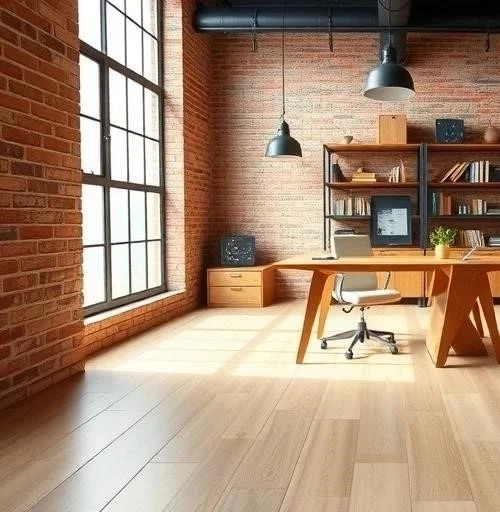
A loft office needs to feel distinctive without becoming difficult to maintain. Quartz vinyl can help achieve both aims: it offers the visual character of concrete‚ stone or wood‚ while providing a durable surface for daily work. Choosing the right floor is not merely a decorative decision; it affects comfort‚ maintenance and how effectively the room supports different tasks.
Why it works in a loft
Exposed brick‚ metal fixtures and open ceilings give a loft its industrial style. A carefully selected quartz vinyl floor complements these elements without competing for attention. Concrete-effect planks reinforce an urban look‚ while wood-effect designs soften the room and make it more welcoming. Stone-effect finishes can add a calm‚ restrained note. This makes the material versatile for office decoration and for an interior that should look cohesive rather than assembled from unrelated trends.
For a convincing loft office‚ consider the scale and color of the pattern. A muted concrete texture pairs well with brick décor and black metal. A warm wood design can balance cool walls and furniture. Combining materials in the interior works best when one finish leads and the others support it: too many competing textures can make a compact workspace feel busy.
Practical benefits for everyday work
Quartz vinyl flooring is an attractive option for a home office or a small commercial space because it is designed for regular use. A wear-resistant floor can tolerate chair movement and foot traffic; resistance to scratches depends on the product’s protective layer and on sensible care. Moisture resistance is useful near a kitchenette or entrance‚ although spills should still be wiped promptly. Easy maintenance—usually routine sweeping and damp cleaning—helps keep the room presentable without elaborate treatments.
Sound insulation is another consideration. The floor construction and any underlay may reduce some impact noise‚ but results vary‚ so check the manufacturer’s specifications. This matters in an open-plan loft‚ where sound can travel between work and meeting areas. Use rugs or acoustic panels as additional measures rather than expecting the floor alone to solve the problem.
Planning the layout and installation
Use the flooring to support workspace zoning. Running planks in a consistent direction can visually connect the desk‚ reading corner and meeting area; a different rug or furniture arrangement can distinguish each zone without interrupting the open-plan feel. For a practical interior‚ choose a finish that suits the light: pale tones can make a small office feel more open‚ while deeper shades create a more grounded atmosphere.
Installation quality matters as much as appearance. Before laying quartz vinyl‚ prepare a clean‚ dry and level subfloor‚ and follow the product instructions for acclimation‚ expansion gaps and adhesive or click-lock fitting. Professional floor installation is worthwhile when the base is uneven or the room has complex edges. Check compatibility if you plan to use underfloor heating: warm floors and quartz vinyl can work together only within the temperature limits specified by the manufacturer.
A durable choice‚ not a shortcut
Quartz vinyl tile‚ including SPC tile‚ can provide a practical foundation for a loft office‚ but products differ in thickness‚ wear layer‚ construction and warranty. Compare samples in the actual room and assess them under both daylight and artificial light. The best office flooring is the one that supports your work routine‚ suits the architecture and remains easy to care for. With a considered finish and sound installation‚ quartz vinyl can deliver a durable interior that feels unmistakably loft-inspired.
SEO terms: кварцвиниловая плитка (quartz vinyl tile)‚ кварцвиниловое покрытие (quartz vinyl flooring)‚ SPC-плитка (SPC tile)‚ виниловый пол (vinyl floor)‚ отделка кабинета (office finishing)‚ кабинет в стиле лофт (loft office)‚ интерьер рабочего кабинета (office interior)‚ дизайн кабинета (office design)‚ практичный интерьер (practical interior)‚ индустриальный стиль (industrial style)‚ зонирование рабочего пространства (workspace zoning)‚ износостойкое напольное покрытие (wear-resistant flooring)‚ влагостойкость (moisture resistance)‚ устойчивость к царапинам (scratch resistance)‚ шумоизоляция (sound insulation)‚ простота ухода (easy maintenance)‚ укладка кварцвинила (quartz vinyl installation)‚ монтаж напольного покрытия (floor installation)‚ кварцвинил под бетон (concrete-effect quartz vinyl)‚ кварцвинил под дерево (wood-effect quartz vinyl)‚ кварцвинил под камень (stone-effect quartz vinyl)‚ фактура бетона (concrete texture)‚ декор под кирпич (brick-effect décor)‚ сочетание материалов в интерьере (combining interior materials)‚ напольное покрытие для офиса (office flooring)‚ напольное покрытие для кабинета (office flooring)‚ долговечная отделка (durable finish)‚ интерьер в стиле лофт (loft interior)‚ теплый пол и кварцвинил (underfloor heating and quartz vinyl).



6 Comments. Оставить новый
I found the discussion of everyday use helpful because office flooring needs to cope with more than occasional foot traffic. The reminder that scratch resistance depends on the protective layer appropriately avoids implying that every quartz vinyl product performs identically.
The article balances design considerations with maintenance in a clear way. Its advice about wiping spills promptly is especially practical: moisture resistance can be useful, but it should not be treated as a substitute for routine care or for checking the product’s specifications.
The comparison between concrete-, wood- and stone-effect designs gives readers a practical starting point. Matching a finish to existing brick, metal and wall colors is sensible advice, though it is also worth viewing samples in the room’s actual lighting before making a final choice.
The article explains well how flooring can support a cohesive interior without dominating it. I would also consider samples alongside the intended furniture and finishes, but the suggestions on color, texture and practical upkeep provide a strong foundation for that decision.
This is a thoughtful overview for someone planning a loft workspace. The point about acoustic performance is important, since flooring and underlay can affect impact noise, but results vary. Checking product details rather than assuming a particular level of sound insulation is the right approach.
The article makes a useful point that flooring affects more than appearance: comfort, upkeep and the room’s overall character matter too. I especially appreciate the advice to let one finish lead, since combining too many strong textures can make a loft office feel visually crowded.