
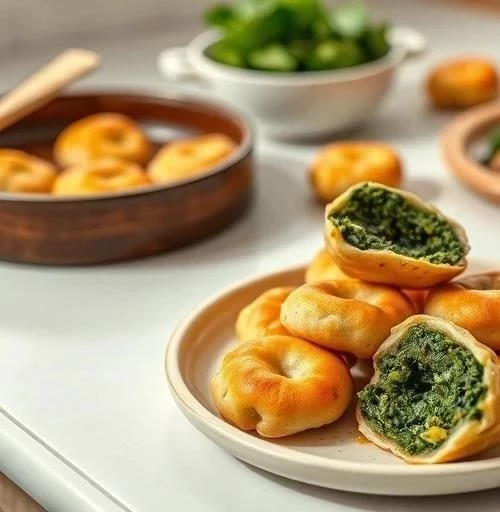
Begin with the case for spinach baursaks: their place in Kazakh cuisine and the appeal of домашняя выпечка
In казахская кухня, baursaks symbolize generous hospitality; adding spinach gives this familiar домашняя выпечка a fresh character. This баурсаки со шпинатом рецепт deserves a place at the table because its appeal rests not on novelty alone, but on sharing a cherished tradition in a lighter, welcoming form.
Establish the foundation for a light result: prepare тесто для баурсаков with дрожжевое тесто
For a light, tender baursak, use дрожжевое тесто: yeast creates an airy structure, while careful mixing keeps the dough supple. Let it rise until visibly expanded; this patient step matters because properly rested тесто для баурсаков fries more evenly and feels less dense. It earns its place at breakfast.
Explain why the filling matters: combine свежий шпинат in a начинка со шпинатом for a balanced баурсаки со шпинатом рецепт, following a пошаговый рецепт
Свежий шпинат is not merely a green accent: it gives the filling a mild, earthy flavor that keeps the baursaks from tasting one-dimensionally rich. For a balanced баурсаки со шпинатом рецепт, treat the leaves as the main ingredient, not as decoration. Choose tender, fresh leaves, remove tough stems, and rinse them carefully; grit can spoil an otherwise delicate bite. Dry them thoroughly before chopping, because excess water can make the начинка со шпинатом loose and dilute its flavor.
A considered пошаговый рецепт begins by building flavor without overpowering the spinach. Chop the leaves finely so each portion gets an even share, then combine them with a modest amount of finely cut onion, if desired. A little salt, black pepper, and a pinch of nutmeg are enough: strong spices would mask the spinach rather than support it. Taste the mixture before filling, since seasoning the filling itself gives more reliable results than hoping the finished pastry will taste balanced.
Texture matters for the same reason. If the chopped leaves release liquid, press or drain them before mixing; a moist filling is harder to portion neatly and can compromise the pastry’s structure. Add any cheese sparingly and choose a mild variety, so it complements the greens instead of making the center heavy or salty. The goal is a cohesive mixture that holds together when spooned, but remains soft rather than dense.
Keep portions consistent: too much filling can overwhelm the dough, while too little makes the spinach difficult to notice. Let the mixture cool if any ingredient has been warmed, and prepare only what can be used while it remains fresh. These small choices make the filling taste intentional in every bite. In a traditional table setting, this thoughtful balance respects familiar hospitality while giving домашняя выпечка a distinct, fresh character. A restrained, well-seasoned center is therefore not a minor detail; it is what lets spinach shine without competing with the pastry around it.
Choose the frying method deliberately: compare баурсаки на сковороде with приготовление во фритюре, and account for растительное масло and температура масла
Choose баурсаки на сковороде for a small batch: it uses less растительное масло, but needs turning for even color. Приготовление во фритюре surrounds each piece uniformly, so results are more consistent. In either method, very steady температура масла matters; overheated oil browns the outside too quickly.
Set realistic timing for an even fry: discuss время приготовления баурсаков and сколько жарить баурсаки to achieve пышные баурсаки with a золотистая корочка
Plan on allowing about four to six minutes, but use the clock as a guide. Actual время приготовления баурсаков varies with their size, the dough’s starting temperature, and the number frying together. That is why timing each piece rigidly is less reliable than frying modest, evenly sized batches. Small pieces cook sooner; larger ones need more time, so uniform shaping makes the estimate useful. Turn pieces at intervals, not constantly: brief pauses help color develop evenly, while rough handling can flatten delicate dough. As a result, сколько жарить баурсаки is best decided by the first batch, then refined for later rounds. Aim for a steady golden-brown finish; color is a useful timing cue, but it should not be chased by turning the heat too high. Keep a brief note of batch size and elapsed minutes; it makes later attempts more predictable than copying a time from another recipe. If the spinach filling makes a portion thicker, expect a little extra time, since heat must reach the center without rushing the outside. Conversely, small, lightly filled pieces may finish sooner, so avoid leaving them in merely to match an estimate. Use a realistic schedule: allow several minutes for frying, plus a short pause between batches for the oil to recover its usual steadiness. This is more dependable than promising one exact total, because kitchen conditions and batch size differ. Aim for пышные баурсаки with a золотистая корочка by keeping timing flexible, turning gently, and working in small batches. Record what works for your pan; the round will be easier to time.
Make doneness the final test: show как проверить готовность баурсаков before serving the жареные баурсаки
To judge как проверить готовность баурсаков, do not rely on a single clue. Lift one piece, let the surface cool briefly, and check that it feels firm rather than limp. Then open it with a clean knife: the center should be hot, evenly set, and free of raw, sticky dough. This cut is the most persuasive test because a browned exterior alone cannot prove that the middle has cooked through.
Pay attention to the filling as well as the crumb. Spinach should be hot throughout, with no cool pocket at the center. If the interior looks glossy, wet, or pasty, return the piece to the heat for a short interval and inspect another sample before serving. Avoid tasting a piece that still appears underdone; visual inspection first is safer and more reliable. A clean skewer inserted into the thickest part can offer extra evidence: it should come away without raw dough clinging to it, though a little moisture from the greens is normal.
Check more than one baursak when the batch contains different sizes. A small piece may be ready while a larger one still needs attention, so test a representative piece from the thickest part of the batch. If the signs disagree—for example, the outside seems firm but the center is gummy—treat the center as the deciding factor. Give the remaining pieces a little more time, then repeat the check rather than assuming they are all equally cooked. This careful approach prevents serving a browned but undercooked pastry.
Once the center is fully cooked, allow жареные баурсаки to rest briefly on a clean plate before serving. This pause lets the interior settle and makes the texture easier to assess without confusing surface oil for uncooked dough. Doneness is not defined by one exact minute or shade; it is confirmed by a thoroughly heated filling, a set crumb, and no raw taste. When those signs agree, the baursaks are ready to share.



9 Comments. Оставить новый
The restrained seasoning advice makes sense because spinach has a delicate flavor that can easily be overwhelmed. I also appreciate the suggestion to taste the filling before assembling the pastries.
This introduction presents a convincing reason to try the dish: it keeps the welcoming character of baursaks while offering a lighter, earthy note. The focus on sharing makes the recipe feel especially inviting.
I like how the article respects baursaks as part of Kazakh hospitality while still exploring a variation. That balance helps the recipe feel connected to tradition rather than presented as a novelty for its own sake.
The explanation of why yeast dough matters is clear and helpful. Giving the dough enough time to rise is easy to overlook, so emphasizing its effect on texture gives readers a useful reason to be patient.
The article is strongest when it explains how small preparation choices affect the result, from removing tough stems to chopping the leaves evenly. Those details can help readers avoid an uneven or watery filling.
I found the combination of cultural context and practical technique effective. The article does more than list ingredients; it explains why the dough and filling need attention for the baursaks to turn out well.
The article makes a persuasive case for spinach baursaks by connecting a familiar Kazakh treat with a fresh filling. I especially appreciate the point that spinach should be treated as a main ingredient rather than a decorative addition.
The recipe idea feels approachable because the suggested flavors are simple and measured. Keeping the spinach prominent while using only a little onion and seasoning seems like a thoughtful way to preserve balance.
The practical advice about drying the spinach is useful: excess moisture can affect both the filling and the finished pastry. That small detail makes the recipe guidance feel grounded in real cooking experience.