
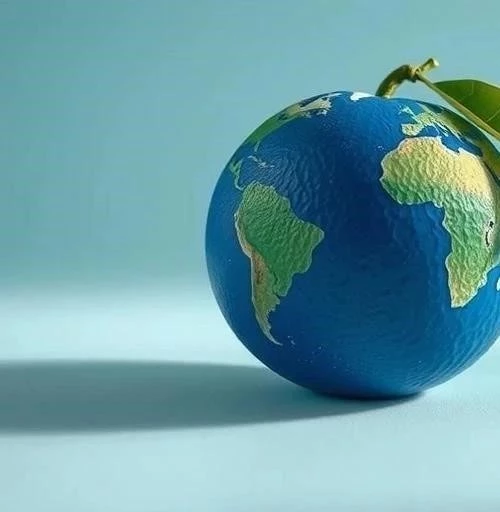
“The Earth is blue like an orange” sounds like a mistake‚ a riddle‚ or a line from a dream. Blue and orange are usually treated as opposites: one suggests ocean‚ sky‚ and distance; the other suggests fruit‚ warmth‚ and sunlight. Yet the phrase does not ask us to choose between them. It invites us to look at our planet—and at language—from an unexpected angle. The Earth can be blue in appearance and orange in imagination‚ while remaining entirely itself.
A planet seen from space
From space‚ Earth is often described as a blue planet. Vast oceans cover most of its surface‚ and clouds‚ air‚ and light soften the view into shifting shades of blue and white. The color is not a simple coat of paint: it changes with the atmosphere‚ the angle of sunlight‚ the weather‚ and the part of the world being observed. A satellite image may show deep-blue water‚ pale cloud systems‚ green forests‚ and brown deserts all at once. The familiar “blue Earth” is a real impression‚ but never the whole story.
Modern digital globes make that complexity easier to explore. Services such as Google Earth assemble imagery and geographic data so that viewers can move from a view of the entire planet toward streets‚ coastlines‚ and mountain ranges; Such images help us understand Earth as a connected place‚ but they are still representations: collected at different times‚ processed‚ and displayed on a screen. Looking closely reminds us that the planet is not a single picture. It is a changing world that no one viewpoint can contain.
Why bring an orange into the sky?
An orange is round‚ vivid‚ and recognizable. Its color seems to belong to the opposite side of the blue planet‚ but its shape offers a useful comparison: Earth‚ too‚ is broadly spherical. The resemblance stops there. Our planet is not perfectly round‚ and its surface is not smooth like fruit skin. It is an active world of oceans‚ continents‚ ice‚ air‚ and living things. The orange in the phrase is therefore not a scientific model. It is a playful image that makes a familiar object strange.
The words also challenge the habit of treating comparisons as strict equations. The Earth is not literally an orange‚ and an orange is not blue. But each object can borrow qualities from the other in a poem: a planet can seem fruit-like in its roundness‚ while an orange can acquire the color of a distant sea in the mind. The sentence lets two impressions coexist. Its apparent contradiction is not a failure of logic so much as an invitation to notice how flexible perception can be.
Poetry and productive contradiction
The phrase is widely associated with the French poet Paul Éluard and the surrealist tradition‚ which often placed ordinary images together in startling combinations. Surrealism treats imagination not as an escape from reality but as another way to reveal it. When the Earth becomes “blue like an orange‚” the reader pauses. That pause can make the familiar planet feel newly visible: immense yet intimate‚ scientifically describable yet emotionally mysterious. The image opens a door rather than delivering a literal fact.
Contradictions can also express experiences that plain description struggles to hold. Earth is both home and a remote sphere; fragile from the perspective of life and immense on a human scale; mapped in detail and still full of unknowns. Blue may suggest the planet as seen from orbit‚ while orange brings it close to the hand‚ like something small enough to hold. The contrast moves between distance and touch‚ knowledge and wonder.
Seeing the planet responsibly
Poetic vision does not replace observation. Earth is the third planet from the Sun and the only world currently known to support life. Its oceans‚ atmosphere‚ and ecosystems make that life possible‚ and they are interconnected. Images from space can encourage awe‚ but they can also remind us that the blue surface is not an inexhaustible backdrop. Pollution‚ climate change‚ habitat loss‚ and resource use are problems on one shared planet‚ crossing the borders that maps draw.
To call Earth blue like an orange is to keep two kinds of attention alive. We can study the world through measurements‚ photographs‚ and geography‚ while also allowing metaphor to refresh our sense of belonging to it. Science helps explain what we see; poetry helps us ask what it means to see it at all.
A world that remains surprising
The phrase endures because it turns a simple description into a small adventure of thought. Earth is blue from space‚ orange only in a poet’s impossible comparison—and somehow the comparison makes the real planet more vivid‚ not less. Look up at a globe‚ zoom in on a digital map‚ or imagine the round world turning in darkness. The colors may change‚ but the invitation remains: see the familiar again‚ and let wonder make room for more than one truth.
9 Comments. Оставить новый
I like how the article uses the surprising comparison between Earth and an orange to invite readers to think about familiar things in a new way.
The article balances poetic imagery with accessible facts, making its central comparison feel both imaginative and grounded.
I appreciate the reminder that a digital globe is a representation rather than the planet itself. That point gives the article an interesting layer.
A charming reflection on color, shape, and perspective. The opening phrase stays with you and makes the reader want to consider Earth more closely.
The explanation of Earth’s changing colors is clear and engaging. It reminds us that images of our planet capture only one moment and perspective.
This is a thoughtful introduction to how language can reshape our perceptions. The phrase feels playful, but it also leads into real observations about Earth.
I enjoyed the way the article moves from a view of Earth from space to the limitations of looking at it through a screen. It encourages curiosity.
The writing is vivid without being difficult to follow. The descriptions of oceans, clouds, forests, and deserts help readers picture Earth’s variety.
The contrast between blue and orange makes the opening memorable, while the discussion of satellite imagery adds useful context.