
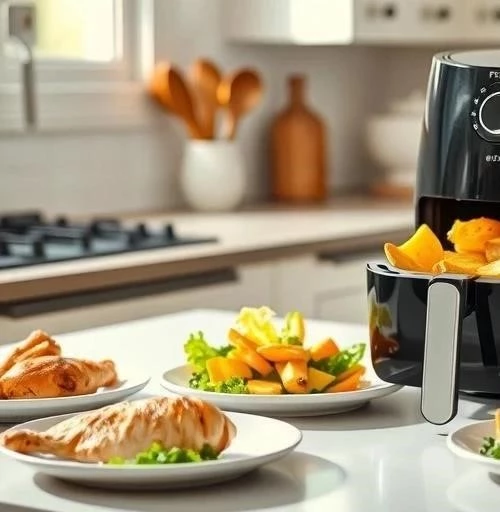
An air fryer is a countertop appliance that cooks food by circulating hot air around it. Despite its name, it does not usually fry food in a bath of oil. Its compact cooking chamber and moving air can brown and crisp many ingredients, often with only a light coating of oil. The results depend on the appliance, the amount of food, and how it is prepared.
Foods that work well
Vegetables: Potatoes, sweet potatoes, carrots, broccoli, cauliflower, Brussels sprouts, peppers, courgettes and green beans can be roasted until browned and tender. Cut pieces to a similar size, dry washed vegetables, and add a small amount of oil and seasoning. Leafy greens are more delicate and may blow around in the basket, so they need careful preparation.
Potatoes and other sides: The appliance can cook chips, wedges, hash browns and other frozen potato products. Fresh chips generally benefit from soaking or rinsing to remove surface starch, followed by thorough drying. Shake or turn them during cooking for more even browning.
Meat and poultry: Chicken wings, drumsticks, breast pieces, meatballs, sausages and small cuts of pork or beef can be cooked in an air fryer. Arrange them with space around each piece rather than packing the basket tightly. Check doneness with a food thermometer where appropriate; colour alone is not a reliable safety test.
Fish and seafood: Salmon portions, white fish fillets, prawns and breaded fish can be cooked with little added fat. Delicate fillets may be easier to handle in a suitable liner or small oven-safe dish, provided it does not block airflow.
Frozen convenience foods: Many frozen products, including nuggets, spring rolls, fish fingers and some pastries, are suitable. They can often be cooked directly from frozen, but package instructions should be treated as a starting point because air-fryer models vary.
Baking and reheating
An air fryer can bake small cakes, muffins, biscuits, fruit desserts and savoury items such as mini quiches, using heat-safe dishes that fit inside the cooking chamber. It can also reheat pizza, breaded foods and leftovers, restoring some crispness that a microwave may not provide. Thin or sugary items can brown quickly, so check them before the suggested time has passed.
How to get better results
- Preheat only when the recipe or appliance instructions recommend it.
- Leave room for hot air to circulate; cook in batches if necessary.
- Turn or shake food partway through cooking, when safe to do so.
- Use a little oil where it helps browning, but avoid pouring oil into the appliance.
- Start checking early and adjust time and temperature for your model and portion size.
What it cannot do
An air fryer is not ideal for large quantities, foods that need a wet batter, or recipes requiring substantial liquid. Loose batter may drip before it sets, while overcrowding can leave food pale or unevenly cooked. It also does not make every dish automatically lower in calories: the ingredients and portion size still matter. A small capacity may mean several batches for a family meal.
Cleaning and safety
Allow the appliance to cool before cleaning. Wash the basket and tray according to the manufacturer’s instructions, remove grease and crumbs, and keep the heating element clear. Use accessories rated for cooking and sized so they do not obstruct airflow. In short, an air fryer is versatile for roasting, crisping, baking and reheating, but good results come from suitable foods, sensible spacing and checking that each dish is fully cooked.



9 Comments. Оставить новый
The article gives a clear overview of the foods that can be prepared in an air fryer and explains that results vary by appliance and preparation.
The practical advice about spacing food in the basket and turning it during cooking is useful for readers who are new to air frying.
The food categories make the information easy to scan, while the preparation notes add helpful detail beyond a basic list.
The article appropriately notes that package directions and cooking results can differ between air-fryer models.
The explanations are straightforward and measured, without suggesting that every food will cook identically in every appliance.
The discussion covers fresh, frozen, and delicate foods, giving readers a balanced sense of what the appliance can handle.
The distinction between air frying and cooking in oil helps set realistic expectations about how the appliance works.
The guidance on drying vegetables and arranging ingredients with room around them is specific and easy to apply.
The reminder to use a food thermometer for meat and poultry is an important food-safety point.