
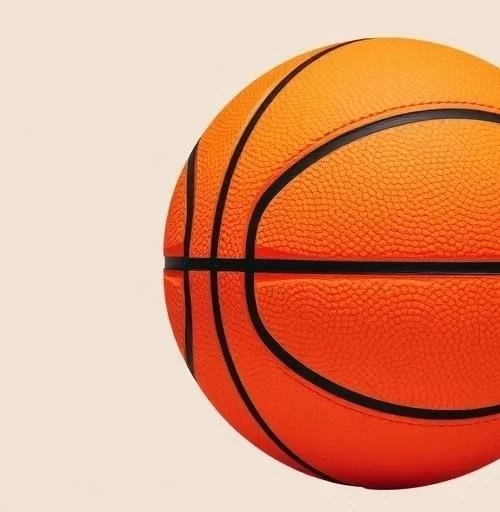
A basketball is a round, inflated ball designed for bouncing, passing, and shooting. Its familiar appearance is practical: the shape, surface, and markings help players grip it and follow its movement. Although balls vary in size, color, and material, most have the same basic design.
Shape and size
The ball is spherical, with a slightly pebbled outer surface. When viewed from the side, it looks like a circle; from any angle, it has a smooth, rounded outline. A properly inflated basketball keeps this shape rather than appearing flat or misshapen. Its size depends on the player group and rules. Adult men commonly use a size 7 ball, while women and many youth players use smaller sizes.
Color and panels
Traditional basketballs are orange or brown-orange, with dark lines that divide the surface into broad sections. The lines form curved channels that meet at several points, creating the recognizable panel pattern. They do not usually indicate separate pieces that can be removed; on a finished ball, the outer cover appears continuous, with the grooves set into it.
Orange remains common because it is easy to distinguish against many indoor court floors and backgrounds. However, basketballs are also made in other colors, including black, blue, red, and white. Some have multiple colors or printed graphics. These variations change the ball’s appearance, but not its round shape or basic panel layout.
Surface and texture
A basketball does not usually have a completely smooth finish. Its cover is covered with small raised dots or a similar textured pattern. This pebbled surface helps a player’s fingers make contact with the ball. The channels between panels provide additional places for the fingers to rest. From close up, the texture is easy to see; from a distance, it may look like a fine grain.
The material varies. Indoor balls may have a leather or composite cover, while many outdoor balls use rubber or durable synthetic materials. A new ball can look slightly glossy or matte, depending on its finish. With use, dirt, wear, and scuffs may change its color and texture, especially on outdoor courts.
Lines and lettering
The dark channels are among the most noticeable features. They curve around the ball and divide its surface into panels, while remaining visible as the ball turns. The pattern also helps players orient their hands when holding or spinning it. The channels are typically dark brown or black, though their color can differ on specially designed balls.
Most basketballs also display a brand name, logo, or model information. These markings are printed on one or more panels and may include small text, size details, or graphics. They are usually secondary to the main color and dark lines. On a worn ball, lettering may fade, peel, or become partly obscured by dirt.
How it looks in use
When held, a basketball is large enough to fill much of an adult’s hands, though the exact impression depends on the ball size and the person holding it. During play, it changes appearance as it rotates: the panel lines sweep across the viewer’s field of vision, and the logo may briefly turn into view. When bouncing, the ball compresses slightly at the point of impact and then returns to its rounded form.
In short, a typical basketball looks like an inflated orange sphere with dark curved grooves, a textured surface, and printed markings. The details differ between models, but the combination of a rounded shape, visible channels, and grippy finish makes the object easy to recognize.
Quick visual checklist
- A round, inflated shape.
- A pebbled or lightly dimpled outer texture.
- Dark curved channels dividing the surface into panels.
- Usually an orange or brown-orange color, though other colors are common;
- Printed branding or other small markings on the cover.

1 Comment. Оставить новый
The article gives a clear overview of basketballs’ shape, colors, panels, and surface texture, while noting how materials can vary by use.