
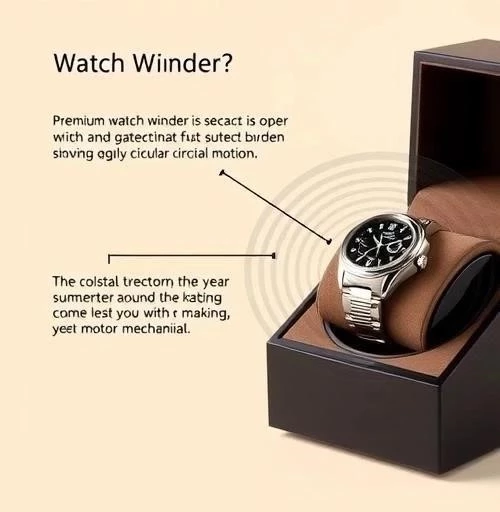
A watch winder is a powered holder that gently rotates an automatic wristwatch while it is not being worn․ Its purpose is to keep the watch’s movement running, rather than merely to display or store it․ The device is designed for watches that wind themselves through the motion of the wearer’s wrist․
How an automatic watch stays powered
An automatic watch contains a rotor: a weighted part that moves as the watch changes position․ Through the movement’s winding mechanism, the rotor tightens the mainspring, which stores energy and drives the hands․ When the watch is left still, it eventually uses up that stored energy and stops․ The time it continues to run without further winding is its power reserve; the exact duration depends on the model․
A winder turns the watch in a controlled pattern, moving its rotor and replenishing the mainspring․ It does not need to imitate every motion of a human arm․ Instead, it provides enough rotation, in the appropriate direction and amount, to maintain the reserve for many automatic movements․ If the watch stops, a winder may restart it, although setting the time and date can still be necessary․
What it does—and what it does not do
A winder can be convenient if you rotate several automatic watches and dislike resetting a watch each time you wear it․ This is particularly relevant to watches with complicated calendars, moon phases, or other indications that take time to set․ Keeping a watch ready can also make a collection easier to enjoy and present․
However, a winder is not essential for an automatic watch․ Most such watches are designed to stop safely when their power reserve runs out․ You can wind and set the watch again when you want to wear it․ A winder does not improve accuracy, service a movement, or make a watch more valuable․ It is a convenience, not a requirement for proper ownership․
Nor is it a universal charger․ A manual-wind watch generally needs to be wound by its crown, while a quartz watch runs on a battery or another electrical power source․ Rotating either type usually serves no useful purpose unless its maker specifically says otherwise․ Check the watch’s manual before buying a winder․
Settings: turns, direction, and rest
Winders commonly offer settings for rotations per day (TPD) and turning direction: clockwise, counterclockwise, or alternating․ The correct combination depends on the movement․ Some automatic mechanisms wind in both directions; others wind efficiently in only one․ A setting that works for one watch is not necessarily right for another, even if both look similar․
Look up the manufacturer’s recommendation for your exact movement, or ask a qualified watchmaker․ Choose a winder that can provide the recommended direction and a suitable TPD range․ More rotation is not automatically better․ Many modern automatic movements include a mechanism that prevents the mainspring from being wound beyond its intended tension, but excessive operation still means unnecessary motion and wear․ A well-configured winder often turns intermittently, allowing the watch to rest between cycles․
Choosing a suitable model
- Fit and support: The cushion or holder should secure the watch without stretching its strap or pressing hard on the bracelet․ Confirm that it accommodates the case size and strap length․
- Capacity: Buy for the number of watches you will actually keep running․ A single-watch unit can be enough; larger cabinets may suit a collection but take more space․
- Power and placement: Models may use an adapter, batteries, or both․ Battery operation can be useful where a cable is inconvenient, but check expected battery life․ Place the unit on a stable surface away from moisture and extreme temperatures․
- Noise and controls: If it will sit in a bedroom or office, look for quiet operation and clear, adjustable settings․ A timer or rest cycle can help match the watch’s needs․
- Build quality: Smooth rotation, secure fittings, and reliable controls matter more than decorative features․ Do not assume an expensive-looking case guarantees suitable settings․
Care and common concerns
Use the winder only as directed, and handle the watch gently when fitting or removing it․ Keep the device clean and check that the watch is held firmly before starting it․ If a watch becomes magnetized, inaccurate, or stops despite correct settings, a winder is not the remedy; have the watch assessed by a watchmaker․ Keep the unit away from strong magnetic fields unless its maker confirms that it is safe for watches․
For long-term storage, consider whether keeping the movement running is worthwhile․ A stopped watch avoids continuous operating time, while a running one saves the effort of resetting it․ Neither choice is automatically harmful when the watch is stored appropriately․ Follow the manufacturer’s care guidance, especially for watches with complex calendars or special winding instructions․
Bottom line
A watch winder is a rotating device for maintaining the power reserve of a compatible automatic watch․ It is most useful when convenience matters—particularly for frequently worn watches that are awkward to reset․ It is unnecessary for many owners, and incorrect settings can create needless movement rather than benefit․ Confirm compatibility, use the movement’s recommended TPD and direction, and treat the winder as an optional accessory, not a substitute for ordinary watch care․



7 Comments. Оставить новый
The explanation clearly distinguishes what a watch winder does from what it cannot do. Emphasizing that it is a convenience rather than a necessity helps readers make a practical decision without assuming that an automatic watch must always be kept running.
This is a clear introduction for someone new to automatic watches. Explaining power reserve in plain language gives readers the context they need before considering whether a winder would actually be useful for their routine.
I appreciate the balanced discussion of convenience and necessity. The examples of complicated calendars and moon-phase displays show why some owners might value a winder, while the reminder that a stopped watch can simply be reset keeps the advice grounded.
The description of the rotor and mainspring makes the basic mechanism easy to understand. It also helps explain why controlled rotation can maintain a watch’s power reserve without needing to reproduce every movement of a person’s wrist.
The practical point that a stopped watch may still need its time and date set is especially helpful. It sets realistic expectations and shows that a winder can reduce repeated setup without necessarily eliminating it.
The article makes a useful distinction between maintaining a watch’s power and improving its performance. Clarifying that a winder does not improve accuracy or replace servicing helps prevent common misunderstandings about what the device can accomplish.
The article presents watch winders as an optional tool rather than a requirement for responsible ownership. That measured framing is valuable because it lets readers weigh convenience against their own habits and the features of their watches.