
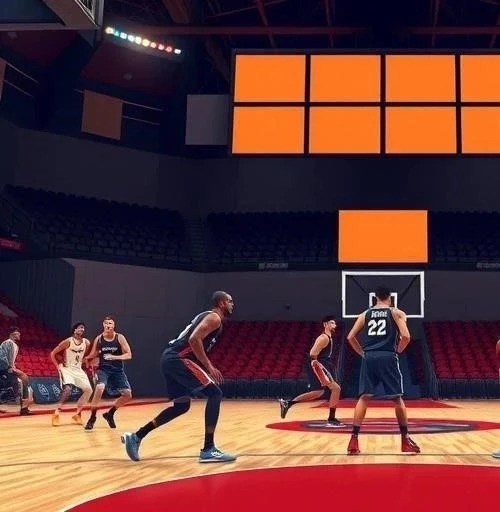
In basketball, a timed segment of play is commonly called a period. In many leagues, the more specific everyday term is a quarter. The two words are related, but they are not always interchangeable in every competition: the rules and the format of the game determine how many periods are played and how each one is named.
The usual answer: a quarter
In the NBA and in most international games played under FIBA rules, a regulation game is divided into four equal periods. Each is called a quarter because it represents one fourth of the scheduled playing time. NBA quarters last 12 minutes each; FIBA quarters last 10 minutes each. Thus, if someone asks for another name for a basketball period, “quarter” is usually the clearest answer.
The word “period” is still correct. It is a general term for one section of a game, while “quarter” identifies a section in a format with four parts. Rulebooks and commentators may use both terms, though fans often say “first quarter,” “third quarter,” or simply “the period.”
Not every basketball game uses quarters
Some competitions divide the game into two halves rather than four quarters. A well-known example is U.S. college basketball: men’s NCAA games are generally played as two 20-minute halves, while women’s NCAA games use four 10-minute quarters. Other leagues and formats may have their own timing rules. For that reason, “half” can be an alternative name for a major division of a game, but it is not the right name for each of the four sections in an NBA or FIBA game.
You may also hear people use “period” as a broad, neutral label when they do not want to assume a particular format. It can describe a timed part of play whether the competition uses quarters, halves, or another structure. In everyday conversation, however, a player who says “the second period” in a four-quarter league usually means the second quarter.
What happens between periods?
Short breaks normally separate the quarters. Teams use these intervals to rest, receive coaching, and make substitutions or tactical adjustments. A longer halftime break comes between the second and third quarters in a four-quarter game, or between the two halves in a half-based format. The break is not itself a playing period; the clock is stopped and the teams are not playing regulation basketball.
If the score is tied at the end of regulation, many competitions add an extra playing segment called overtime. Overtime is also a period in the general sense, but it is not another regular quarter. The length and number of overtime periods depend on the rules of the league. If teams remain tied after one overtime, another may be played until a winner is decided.
Quick terminology guide
- Period: a general term for a timed section of a game.
- Quarter: one of four regular sections in a four-quarter format.
- Half: one of two major sections in a two-half format.
- Overtime: an extra period played when regulation ends in a tie, where the rules require a winner.
In short
The usual answer is a quarter: in most professional and international basketball, each regular period is one of four quarters. “Period” remains the broad, correct word, while “half” applies to formats that divide the game into two sections. If precision matters, name the competition, since game length and division rules can vary. The key distinction is simple: a quarter is one specific kind of period, but not every basketball period is necessarily a quarter.
3 Comments. Оставить новый
A clear explanation of why “quarter” is usually the best answer, while still noting that game formats differ across leagues.
The examples from the NBA, FIBA, and college basketball make the distinction between periods, quarters, and halves easy to understand.
Helpful and informative overview. It shows why “period” is a general term and why the specific name depends on the competition’s rules.