
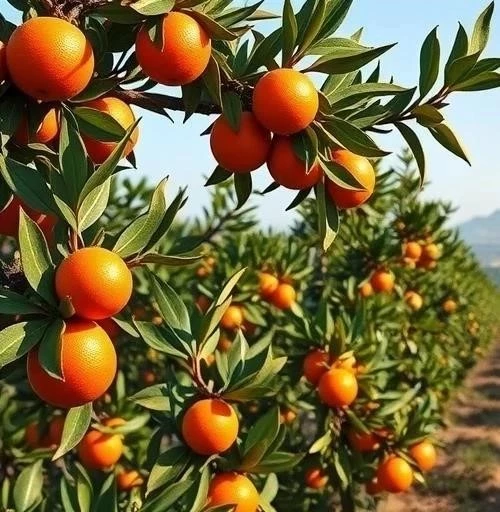
Blood oranges grow in warm citrus-growing regions around the world, especially where summers are sunny and winters are mild. Their best-known home is the Mediterranean, but they are also cultivated in parts of the Americas, Africa, Asia, and the Southern Hemisphere. The fruit grows on evergreen orange trees, just like other sweet oranges.
The Mediterranean heartland
Sicily, in southern Italy, is the region most closely associated with blood oranges. Orchards on the island’s eastern side, particularly around Mount Etna, produce celebrated fruit; The combination of volcanic soils, abundant sunshine, and a distinctive pattern of warm days and cool nights helps create the deep red color. Blood oranges are also grown in other parts of Italy, as well as Spain, Greece, and some areas of France.
Across the Mediterranean basin, growers cultivate them in countries including Morocco, Tunisia, and Turkey. These regions have a suitable climate and established citrus industries. However, the color and flavor can differ from place to place, depending on the variety, local weather, soil, and the conditions during the growing season.
Other growing regions
Commercial orchards can also be found in the United States, especially in California and Texas. Smaller-scale production takes place in other warm parts of the country. Blood oranges are grown as well in Australia and South Africa, where the harvest season falls at a different time of year from the Northern Hemisphere season. Some are cultivated in parts of China and other regions with appropriate citrus climates.
What conditions do the trees need?
Blood orange trees thrive in frost-free or nearly frost-free areas with long, sunny growing seasons. They need well-drained soil, regular water while fruit is developing, and protection from severe cold. A tree can grow in a home garden where the climate is mild; in colder locations, it may be kept in a large container and moved indoors during winter.
Cool nights are particularly useful for developing the fruit’s characteristic red pigments, called anthocyanins. A warm climate alone does not guarantee a strongly colored orange: if nights remain warm, the flesh may be less vividly red. Some varieties can still develop color under different conditions, and fruit from the same orchard may vary in appearance.
Varieties and harvest
The main varieties include Tarocco, Moro, and Sanguinello. Tarocco is strongly associated with Sicily and is often prized for its sweetness. Moro can have especially dark red flesh, while Sanguinello is widely grown in Spain and Italy. The precise harvest period depends on variety and location. In Mediterranean and other Northern Hemisphere orchards, fruit is generally picked from winter into spring. In Southern Hemisphere countries, the seasons are reversed.
In short, blood oranges grow wherever orange trees can flourish, but Mediterranean regions—above all Sicily—are their traditional center. Their vivid color is shaped not just by geography, but by the local climate, the variety, and the temperature changes experienced as the fruit ripens.


3 Comments. Оставить новый
I found the growing conditions section useful, particularly the practical note about keeping a tree in a container in colder climates. This makes the article relevant to home gardeners as well as curious readers.
The article does a great job showing that blood oranges are grown far beyond the Mediterranean. The section about harvest seasons in the Southern Hemisphere adds a helpful perspective.
This is a clear and informative overview of where blood oranges are grown. I especially liked the explanation of how Sicily’s climate and volcanic soils contribute to the fruit’s distinctive color.