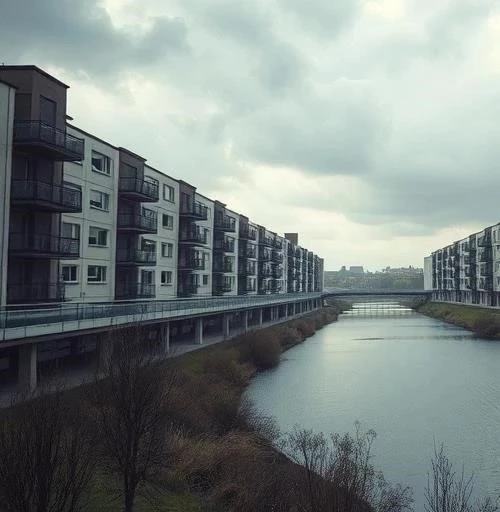
Stanley Kubrick’s A Clockwork Orange was filmed mainly in and around London, using real locations whose stark modernist design helps explain the film’s unsettling atmosphere. The setting is not simply a backdrop: concrete estates, empty walkways and imposing buildings make the future seem both ordinary and alien. Kubrick’s choice of places is therefore central to the film’s visual argument about violence, authority and social control.
Thamesmead: Alex’s world
The most recognisable locations are in Thamesmead, southeast London. Its broad concrete walkways, underpasses and housing blocks provide the landscape around Alex’s home and the droogs’ encounters. In particular, the Southmere area, including the surroundings of Southmere Lake, appears in several exterior scenes. The estate’s planned geometry gives the characters room to move while making the environment feel impersonal. This contrast is effective: the buildings were designed as modern housing, yet Kubrick’s framing turns them into a cold, almost dystopian world.
Thamesmead is often remembered as “the place where the film was shot,” but that description is incomplete. The production selected particular corners and viewpoints, then used composition, lighting and editing to make them feel like parts of one coherent fictional city. The film’s atmosphere came as much from how the locations were photographed as from the architecture itself;
Other London-area locations
Several other scenes were filmed at real sites in Greater London and nearby Hertfordshire. The exterior of the writer Frank Alexander’s house is associated with Skybreak House in Radlett, a striking modernist home designed by Team 4. Its sleek, glass-heavy appearance sharply contrasts with the rougher streets and estates elsewhere in the film. That contrast matters: Alexander’s home seems refined and secure, but the violence that enters it exposes how fragile that sense of safety is.
Brunel University in Uxbridge was also used for institutional interiors connected with Alex’s treatment. Its modern buildings suited the film’s vision of a society that presents coercion as scientific progress. London locations also include the former Chelsea Drugstore on King’s Road, used for the record-shop sequence. The real business has since closed, so visitors should not expect to find the original shop operating there today.
Sets and locations: an important distinction
Not every memorable place in the film was a real building. The Korova milk bar, with its provocative mannequin furniture, was constructed as a set rather than filmed in an actual café. This distinction helps clarify why the film’s world feels so unified: Kubrick combined carefully chosen locations with designed interiors, repeating bold shapes and sterile surfaces across both.
In short: to trace the film, start with Thamesmead, then consider Skybreak House, Brunel University and King’s Road. These sites show that A Clockwork Orange was not shot in one single place. Its unsettling world was assembled from real London-area architecture and purpose-built sets, selected to make modern life appear both plausible and deeply disturbing.