
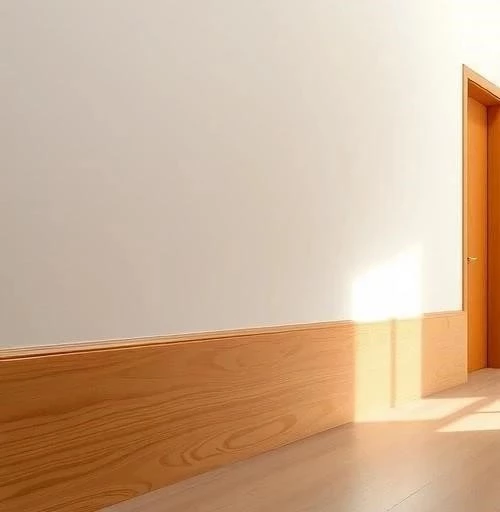
In a thoughtful office, the quietest detail can set the whole room in motion. A wooden baseboard meeting hidden doors turns the wall’s lower edge into a fine architectural line: practical, tactile and almost secret.
A line that disappears—or speaks
Minimalism is not the absence of detail; it is the art of choosing which details deserve attention. A concealed baseboard, or a shadow gap profile, keeps the wall visually light. A traditional wooden baseboard makes a warmer statement, especially when its wood grain echoes the desk, shelving or floor.
For a seamless interior, choose the baseboard color with the wall finish and flooring in mind. Match the finish for visual continuity, or set solid wood against a pale wall as a deliberate accent. Parquet, engineered board and other natural materials each bring a different rhythm; veneer can offer a consistent grain with less visual weight.
Where the doorway becomes a detail
Hidden doors—sometimes called invisible doors—are designed to sit quietly within the wall plane. Their doorway should feel like part of the composition, not a break in it. Align the baseboard with the door leaf, or stop it cleanly at the frame; either choice can look intentional when repeated across the room.
A door opening system and concealed hardware make the effect possible, but precision matters. The wall junction, door clearance and floor level must be planned together. Baseboard installation beside a flush door may require concealed installation and careful coordination with the installer. A beautiful profile cannot rescue a badly resolved edge.
Designing for work
In a modern office, office interior design has to balance calm with durability. Select a timber finish that can handle daily cleaning and choose a profile that won’t collect dust or catch bags. The right interior finishing supports a restrained design without making the room feel cold.
In an office design project, test a full-size sample beside the actual floor, wall finish and door. Check it in daylight and after dark: wood grain changes character as the light shifts. This small experiment can prevent a costly mismatch and make even modest architectural details feel considered.
Use the baseboard to support space zoning, too. A continuous timber line can guide people from reception to meeting rooms, while a subtle change of finish marks a quieter work area. In a corporate interior, these cues create order without adding signs or visual clutter.
The best result is not a baseboard that demands admiration. It is a detail that makes the wall, floor and hidden door feel as though they were conceived together. That is the quiet magic of a well-made office: function stays visible, while the craft slips gracefully out of sight.

5 Comments. Оставить новый
There’s something wonderfully satisfying about treating a doorway, floor and wall as one continuous sentence. The article makes me look at the room’s lower edge as a place where architecture can hide a small, elegant surprise.
I’m taken with the contrast between a shadow gap that almost vanishes and solid wood that announces itself. That choice feels like the difference between a whispered thought and a signature at the bottom of the page.
The best idea here is that a baseboard can behave like punctuation: nearly invisible, yet capable of changing how the whole room reads. I’d love to see the article linger on one real doorway where that tiny line makes the architecture feel quietly theatrical.
The practical note about dust and bags gives this design advice a welcome pulse of real life. A beautiful detail should survive Monday morning, not merely pose well in a photograph.
A hidden door sounds less like a building feature and more like a magician’s promise. This piece wisely brings the spell back to earth with clearances, floor levels and careful planning—proof that even a secret needs excellent engineering.