
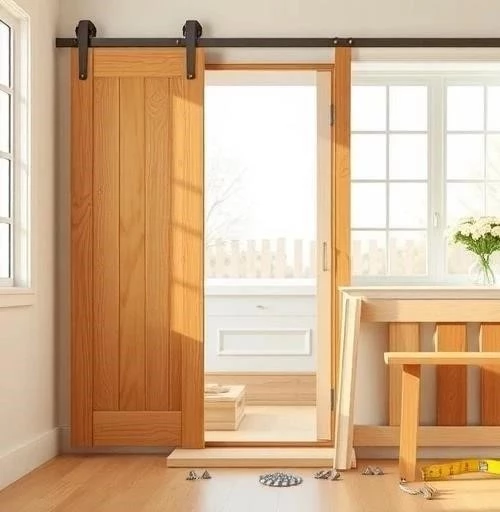
A sliding door can save space, separate rooms and serve as an interior partition. In a cottage, material selection should account for the doorway’s size, the room’s conditions, the desired appearance and the door’s expected service life. Consider the whole assembly: the door leaf, door frame, guide profile, roller mechanism and hardware for sliding doors.
Door leaf materials
Solid wood offers a natural finish and can be repaired, but it is heavy and may respond to changes in humidity. MDF is a stable, versatile option that can be painted or finished with veneer. A laminated panel is generally easy to clean, while PVC can suit utility areas where moisture resistance matters. Compare weight, structural strength and the proposed door finish before choosing.
Glass helps transmit daylight and can make a room feel more open. For safety, choose tempered glass or triplex (laminated safety glass), rather than ordinary glass. An aluminum profile can frame glass panels or create a lightweight structure. Check that the selected material is compatible with the rollers and track.
System and installation
A suspended system carries the door from a guide above the opening, leaving the floor clear. A system of the sliding-coupe type may use floor guidance. A cassette system lets the leaf slide into a pocket in the wall; concealed installation can create a minimal look, but requires planning before finishing the wall. In every case, the guide profile and roller mechanism must be rated for the leaf’s weight.
Professional installation of a sliding door starts with checking the doorway, wall structure and clearances. For installation in a cottage, account for possible settlement and seasonal movement, especially with heavy wood leaves or a pocket system. Correct alignment and suitable hardware reduce wear and help the door move smoothly. Do not assume that a sliding design will provide the same sound insulation or thermal insulation as a well-sealed hinged door; seals and the system’s construction affect both.
How to make the choice
Match the material to the room: consider moisture resistance for kitchens and bathrooms, strength for frequently used openings, and cleaning needs throughout the home. Balance those practical requirements with interior design and space zoning. Request specifications for glass, profiles, rollers and maximum load, and confirm how the frame will be fixed. A well-matched assembly can provide reliable operation and a suitable appearance over its service life.

3 Comments. Оставить новый
The article clearly outlines the main material options and explains how weight, moisture, and safety can affect a sliding door choice. Its reminder to match the hardware to the door is useful.
The comparison of suspended, floor-guided, and pocket systems gives readers a practical starting point. The notes on planning and wall conditions are especially relevant for cottage installations.
The article presents the benefits and limitations of different designs in a balanced way. It also appropriately points out that sliding doors may not insulate as effectively as sealed hinged doors.