
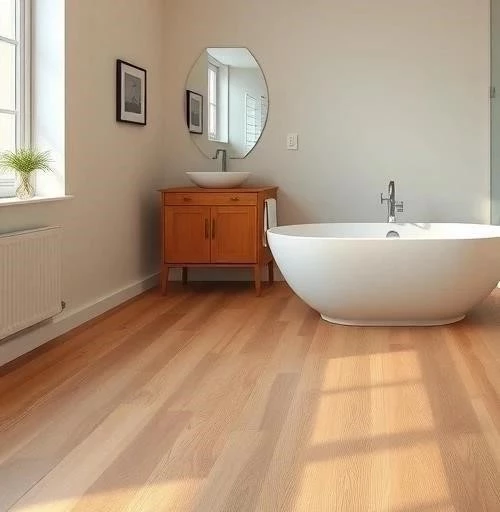
Can engineered wood work in a bathroom? In one bathroom renovation, the owners wanted a warm wooden floor rather than tile throughout. The project showed that engineered wood in a bathroom can be considered, but only with careful material selection, installation and maintenance. It is not waterproof, and the result depends on how well the room is protected from standing water.
Planning and preparation
The team selected a product approved by its manufacturer for rooms with changing humidity. Engineered board and humidity are closely connected: a layered construction may be more dimensionally stable than solid wood, but moisture resistance varies by product and finish. The installer checked the warranty and followed the manufacturer’s guidance before work began.
Substrate preparation came first. The screed was allowed to dry, checked for level and tested for residual moisture. A continuous floor waterproofing system was installed, with particular attention to corners, pipe penetrations and the shower area. These details matter because water entering beneath the boards can cause damage that is difficult to repair.
For installation on screed, the crew used an adhesive specified for the board and substrate. Flooring installation followed the product instructions, including an expansion gap around the perimeter. At the tile transition, a suitable profile created a neat edge while allowing for movement. Joints were sealed where the design and manufacturer’s instructions required it; sealing does not replace waterproofing.
Finish and use
The bathroom had underfloor heating, so the installer confirmed that the chosen board and adhesive were compatible with the system. Heating was introduced gradually, within the recommended temperature limits. For wood protection against moisture, the owners chose a factory-finished surface. Oil for wooden floors and lacquer for engineered wood are both possible finishes, but neither makes the floor impervious to water. The appropriate option depends on the product and its care requirements.
After installation, the owners wiped up splashes promptly, used ventilation and avoided leaving wet bath mats on the floor. This routine is part of wooden floor care and helps limit swelling, open joints and other flooring deformation. Regular inspection of edges and connections is also useful.
Outcome and practical limits
The finished bathroom interior with a wooden floor felt warmer underfoot and visually connected with the adjoining bedroom. The main pros and cons of engineered wood were clear: it offers a natural appearance and can be installed over a prepared screed, but it needs careful moisture control and is less forgiving of leaks than tile. The expected service life of the flooring depends on product quality, installation and maintenance; no fixed lifespan can be guaranteed.
This real installation experience shows that engineered wood can be a considered choice for a bathroom, not a maintenance-free one. Before choosing it, confirm suitability with the manufacturer and installer, plan waterproofing in detail and understand the conditions of everyday use.
7 Comments. Оставить новый
The preparation details, including checking the screed for moisture and level, show why the substrate matters before installation.
The article presents a balanced view by describing possible finishes while noting that neither makes wood impervious to water.
The distinction between sealing joints and installing a waterproofing system is important and is explained clearly.
The article clearly explains that engineered wood is not waterproof and that suitability depends on the specific product and its installation.
The emphasis on checking the manufacturer’s guidance and warranty is useful, since moisture resistance can vary between products.
The section on underfloor heating appropriately points readers toward product compatibility and gradual temperature changes.
The notes about expansion gaps and transitions provide practical context for fitting engineered boards in a bathroom.