
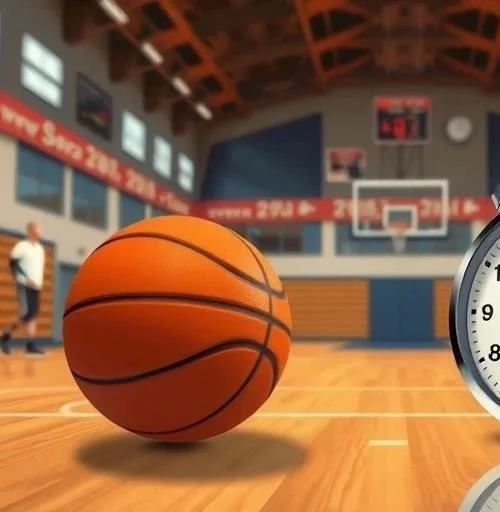
A basketball game has a set playing time, but the time shown on the clock is not the same as the time you will spend watching. The official duration depends on the competition’s rules. Stoppages, halftime and possible overtime make the real event considerably longer.
Official playing time by league
- NBA: Four 12-minute quarters, for 48 minutes of regulation play.
- FIBA competitions: Four 10-minute quarters, totaling 40 minutes. This format is used in many international games and leagues.
- NCAA college basketball: Men’s games use two 20-minute halves; women’s games use four 10-minute quarters. Both formats total 40 minutes.
- U.S. high school basketball: Often four 8-minute quarters, or 32 minutes in total, although rules and quarter lengths can vary by state and competition.
These figures describe regulation time, not a guarantee that the whole game will finish in that number of minutes. The game clock stops for many events, so 40 or 48 minutes of playing time can take much longer in real life.
Why does a game take longer?
The clock usually stops when play is interrupted. Common causes include fouls, free throws, timeouts, substitutions, injuries, reviews and the ball going out of bounds. In the closing minutes, teams may deliberately foul or call timeouts to manage the score, creating especially frequent pauses. Television broadcasts can add commercial breaks as well.
There are also breaks built into the schedule. Players change ends or return to the bench between periods, and halftime is longer than an ordinary quarter break. A close game with many fouls and reviews will generally last longer than a fast-moving game with few interruptions.
Typical time from start to finish
As a practical estimate, allow about two to two and a half hours for an NBA game, including pre-game activity and breaks. Many college or international games take around one and a half to two hours, though broadcasts and stoppages can extend them. A youth or high school game is often shorter, but the venue’s schedule and local rules matter. These are estimates, not fixed limits.
What happens if the score is tied?
If the score is level at the end of regulation, teams play overtime periods until there is a winner. In the NBA, FIBA and NCAA, an overtime period is generally five minutes. High school overtime rules can differ. Each extra period adds playing time, plus the stoppages and breaks around it; several overtimes can make a game much longer.
In short
Basketball regulation lasts 32, 40 or 48 minutes depending on the level and rule set. For planning, expect roughly 90 minutes to two and a half hours for the complete event, and leave extra time for overtime. If you need an accurate estimate, check the competition’s rules and the venue’s schedule.

4 Comments. Оставить новый
A helpful guide for anyone planning to attend or watch a game. I appreciated the practical estimates and the explanation of how stoppages affect the total time.
Clear and informative overview. It does a good job distinguishing official playing time from the full event, which is a detail many new fans may not know.
The article clearly explains why the clock time is much shorter than the time spent watching a basketball game. The league-by-league breakdown is especially useful.
The comparison of NBA, FIBA, college and high school formats makes the differences easy to understand. The examples of common delays add useful context.