
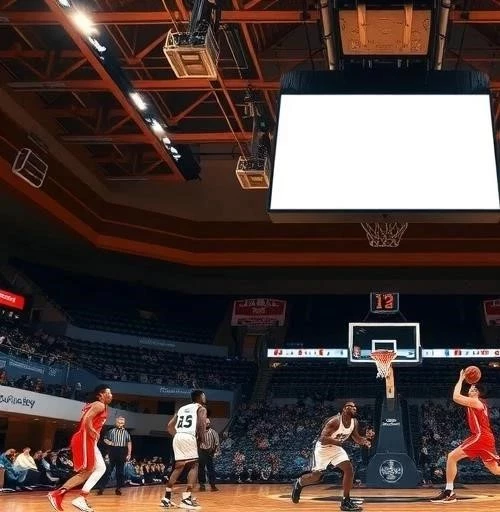
A basketball game has a set amount of playing time, but the event usually takes considerably longer from tip-off to the final buzzer. The official duration depends on the competition: FIBA games use shorter quarters than the NBA, while stoppages, breaks and overtime add time in both formats.
Official playing time
Under FIBA rules, a game consists of four 10-minute quarters, for a total of 40 minutes of regulation playing time. These rules apply to most international competitions and are used in leagues such as the EuroLeague and many national championships.
In the NBA, each of the four quarters lasts 12 minutes. Regulation therefore contains 48 minutes of playing time. The extra eight minutes are part of the official game clock; they do not mean that the NBA simply schedules a longer break between periods.
| Competition | Format | Regulation time |
|---|---|---|
| FIBA | 4 quarters of 10 minutes | 40 minutes |
| NBA | 4 quarters of 12 minutes | 48 minutes |
Why the clock does not run continuously
The figures above are game-clock minutes, not the time you should expect to spend watching. The clock stops for many routine events: when the ball goes out of bounds, a referee calls a foul, a player shoots free throws, a team requests a timeout, or officials review a play. It also stops at the end of a quarter and during certain late-game situations.
As a result, a 10-minute quarter takes longer than 10 minutes in real time. The final minutes can be especially extended: teams may call timeouts, foul intentionally to stop the clock, and take several free throws. A close finish can therefore add a substantial amount of time even without overtime.
Breaks between quarters
There is a short interval between the first and second quarters and another between the third and fourth. The middle-of-game interval, usually called halftime, is longer. Its exact length depends on the league and event, and televised games may also include presentation or broadcast segments. These breaks are not included in the 40 or 48 minutes of regulation time.
Timeouts add further interruptions. Their number, length and administration vary between competitions, and the game may also pause for substitutions, injuries, or officials to check a clock or review a decision. For these reasons, there is no single exact real-world duration that applies to every basketball game.
How long is a game in real life?
As a broad guide, a FIBA game often takes around two hours from start to finish. An NBA game commonly takes about two to two and a half hours, although a particularly close or interruption-heavy contest can run longer. These are practical estimates, not official time limits: the venue, television schedule, pace of play and number of stoppages all matter.
When planning to attend, allow more than the regulation clock time. Arriving early, pre-game introductions, halftime entertainment and delays at the end can extend the visit. If watching a broadcast, commercials and studio segments may also make the program longer than the game itself.
What happens if the score is tied?
If the teams are level at the end of regulation, they play an overtime period. In both FIBA and NBA games, overtime lasts five minutes. It is a full additional period of game-clock time, with a brief interval before play resumes. If the score is still tied when overtime ends, another overtime is played.
There is no fixed maximum number of overtimes in these formats. The game continues until one team is ahead at the end of a period. Every overtime adds five minutes of official playing time, plus the time taken by stoppages and the interval between periods. Consequently, a tied game may last much longer than a typical two-hour event.
How basketball compares with other formats
Not every competition follows the same quarter structure. College basketball in the United States has its own rules, which differ between men’s and women’s competitions and can change over time. Some leagues also set different playing periods. It is therefore best to check the rules for the specific tournament rather than assume that every game lasts either 40 or 48 minutes.
The word “half” can also cause confusion. FIBA and NBA games are divided into four quarters, not two halves, although the interval after the second quarter is commonly called halftime. The total is calculated by adding the four regulation periods; halftime is a break and does not count toward playing time.
In brief
- FIBA: four 10-minute quarters, or 40 minutes of regulation play.
- NBA: four 12-minute quarters, or 48 minutes of regulation play.
- Overtime: five minutes per period in both FIBA and NBA games; additional periods are played if needed.
- Time in the arena: typically around two hours, and often longer for an NBA game or a close finish.
So, the simple answer is that a basketball match lasts 40 minutes under FIBA rules or 48 minutes in the NBA when measured by the official game clock. In real time, expect roughly two hours or more, because the clock stops, scheduled breaks take place, and a tie can send the teams into overtime.


4 Comments. Оставить новый
The article is well organized, and the table makes the difference between FIBA and NBA regulation time easy to see at a glance.
A practical overview for anyone planning to watch a game. It explains the main factors that affect duration without making the rules feel complicated.
I like how this distinguishes game-clock time from real-world duration. The examples of stoppages and late-game timeouts make the explanation easy to understand.
A clear and useful explanation of why basketball games take longer to watch than their official playing time suggests. The FIBA and NBA comparison is especially helpful.