
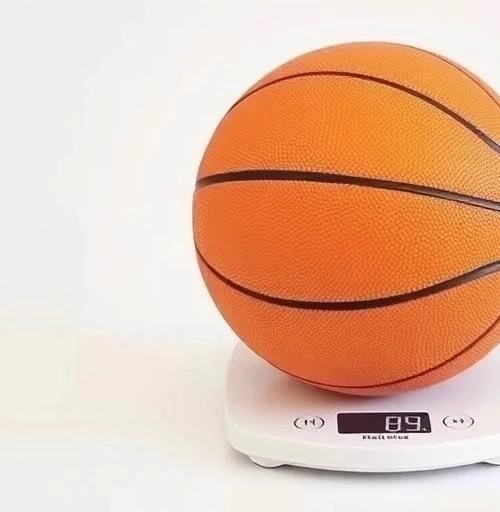
A basketball may look like a simple orange sphere, but pick one up and you are holding a carefully tuned piece of sporting equipment. Too light, and it can flutter off course; too heavy, and every pass feels like a small medicine-ball workout. The short answer is that a regulation basketball weighs roughly 510 to 650 grams, depending on its size and the rules it is made for. The longer answer involves age, competition, materials—and a surprising amount of physics.
The weight depends on the size
Basketballs come in numbered sizes. The number tells you more than the ball’s weight: it also points to its circumference and intended players. Here are the common ranges:
- Size 7: about 580–620 grams under FIBA specifications. This is the standard men’s competition ball, with a circumference of approximately 75–78 centimetres. Many NBA balls weigh close to 624 grams.
- Size 6: about 510–550 grams. It is the usual women’s competition ball and is also commonly used by younger players. Its circumference is roughly 72–74 centimetres.
- Size 5: about 470–500 grams. This smaller ball is often chosen for children, with a circumference near 69–71 centimetres.
- Mini balls: these vary widely. They are made for play, souvenirs, or practice rather than one universal competition standard, so check the manufacturer’s label.
Exact limits can differ slightly between governing bodies, age groups, and product specifications. That is why two balls both labelled “size 7” may not weigh precisely the same amount. A specification is a range, not a promise that every ball will leave the factory at one magical number.
Why are there different sizes?
Basketball is a game of control. A ball should fit a player’s hands well enough to pass, dribble, and shoot without forcing awkward technique. A smaller, lighter ball is easier for many children to handle; a full-size ball offers adult players the feel and resistance expected in higher-level competition. Women’s competitions commonly use size 6, while men’s competitions commonly use size 7—not because one game is less demanding, but because the ball is selected to suit the players and the competition’s standards.
The difference can sound tiny on paper. Yet 70 or 100 grams becomes noticeable when the ball is repeatedly accelerated, stopped, spun, and caught. In a fast game, that little extra mass travels through every pass and rebounds into every dribble.
Air pressure changes the feel, not the category
A basketball’s weight is not the same thing as its bounce. Air pressure mainly affects how lively or firm the ball feels, while the ball’s cover, bladder, and construction contribute to its mass. Pump one up too little and it may thud against the floor; overinflate it and it can rebound sharply and feel uncomfortable to catch. For the correct pressure, look near the valve or consult the manufacturer’s instructions. Many competition balls are used around 7.5–8.5 psi, but the printed recommendation takes priority.
Temperature, wear, and moisture can also change how a ball behaves. A damp leather or composite cover may feel heavier in the hand, even if a scale shows only a modest difference. Dust and grime affect grip, while a slow leak changes the bounce over time. The ball’s actual mass, meanwhile, can be checked with an ordinary kitchen or parcel scale.
Indoor, outdoor, leather, and composite
Material matters, though size and official specifications matter more. Indoor balls often have leather or composite covers designed for grip on polished courts. Outdoor balls typically use tougher rubber or durable composite material to survive rough pavement. Different models can vary slightly in weight because their layers, bladder, and surface construction differ. Still, an outdoor ball is not automatically much heavier than an indoor ball: both should stay within the range intended for their size if they are regulation products.
A quick way to choose
- Check the player’s age group and the league’s rules.
- Choose the recommended size before comparing brands or materials.
- Look for the stated weight and circumference if regulation play matters.
- Use an indoor or outdoor model suited to the court, and keep it inflated as directed.
For casual play, comfort and grip may matter more than a difference of a few grams. For training or competition, matching the official size helps a player develop a consistent touch. A ball that feels natural in the hands is more useful than one that merely looks impressive on a shelf.
So, what does a basketball weigh?
For the familiar adult game, think around 600 grams: a size 7 ball is generally about 580–620 grams, while a size 6 is about 510–550 grams. Children’s size 5 balls are lighter still, usually around 470–500 grams. The precise figure depends on the standard and model, but the purpose is always the same: the ball should be heavy enough to fly with confidence, and manageable enough to make the next pass feel effortless.
In other words, a basketball weighs a little more than a loaf of bread—and, in the hands of a good player, just enough to turn a round piece of rubber into a perfectly timed assist.
1 Comment. Оставить новый
I’ll never look at a basketball as just a ball again: it’s a tiny negotiation between hands, gravity, and the rules of the game. The “magical number” image makes the specifications feel unexpectedly human—close enough to share a label, yet each ball has its own little personality.