
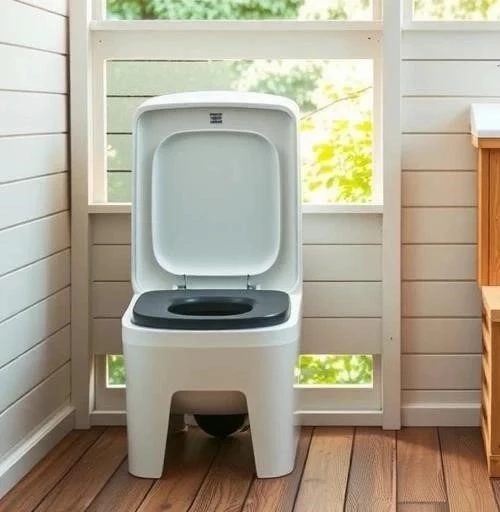
The best dry toilet for a summer cottage depends on how often it will be used, whether the house has electricity and running water, and how the waste can be managed. A model that suits occasional weekend visits may be inconvenient for a family staying all summer. Before choosing, consider installation, capacity, maintenance, winter conditions and the cost of consumables.
Main types of dry toilets
Portable chemical toilet
This compact unit has a flush-water tank and a sealed waste tank. A special liquid helps control odour and break down waste; the tank must be emptied at an authorised disposal point. It is usually easy to install and can be moved, making it practical for infrequent use or a cottage without a permanent toilet room. Check the tank capacity and the manufacturer’s guidance on chemicals: not every additive is suitable for a septic system or composting.
Peat or composting toilet
These toilets use peat, sawdust or another approved cover material to absorb moisture and reduce odour. Some models separate urine from solids, which can make handling easier, but they still require regular attention. Waste needs to be removed and processed in accordance with local rules; it should not automatically be treated as ready-to-use garden compost; A ventilated, frost-protected installation is important, especially with frequent use.
Electric toilet
Electric models may dry, dehydrate or otherwise process waste, depending on their design. They can reduce the frequency of handling, but need a reliable power supply and suitable ventilation. Purchase and operating costs are often higher than for simpler units. Read the specifications carefully: “electric” does not necessarily mean that waste can be discarded without further handling.
How to choose
- Frequency and number of users: Estimate daily use, including guests. A small tank can fill quickly in a busy household, while a large one may be unnecessary for occasional visits.
- Location and installation: Measure the room, check access for emptying, and plan ventilation where the chosen model requires it. A unit should be stable, comfortable to use and protected from freezing.
- Waste disposal: Find out in advance where the contents can legally be emptied or processed. Follow local sanitation requirements and the manufacturer’s instructions.
- Running costs: Compare not only the purchase price but also liquids, cover material, liners, electricity, replacement parts and the effort needed for cleaning.
- Odour control: Correct use, regular emptying, clean seals and adequate ventilation matter for every type. Avoid relying on fragrance to solve a maintenance problem.
Which option suits a typical cottage?
For occasional weekend use, a portable chemical toilet is often the simplest choice if there is an appropriate disposal point nearby. For longer seasonal stays, a peat or composting model may be preferable when users can manage the routine and there is a suitable place for waste processing. An electric unit may be worth considering where power is dependable and reduced handling justifies the extra expense.
Practical checks before purchase
Review the capacity, dimensions, seat height, cleaning method and availability of replacement parts. Ask whether the model needs water, electricity, drainage or a separate ventilation pipe. Confirm how often its tank or container must be emptied under realistic use, rather than relying only on the maximum figure in the product description. If the cottage is unheated in winter, check the permitted operating temperature and storage instructions.
1 Comment. Оставить новый
The comparison outlines the main options and highlights practical factors such as capacity, power supply, ventilation and waste handling. The reminder to check local disposal rules is particularly useful, since requirements can vary. A brief note on typical maintenance frequency for each type would make the guide even more helpful.